
举
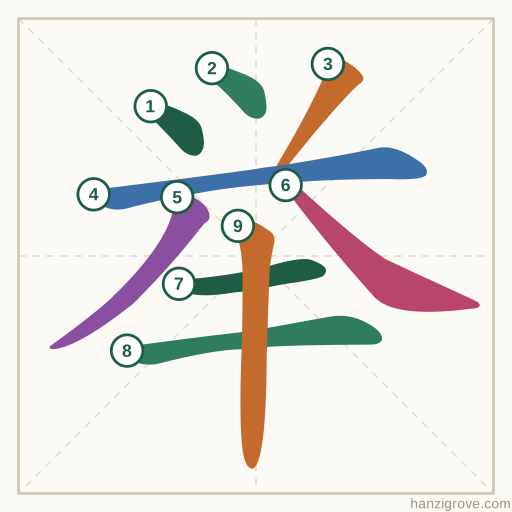
举 (jǔ) means “to raise”. It is made of 兴 + 扌 and has 9 strokes, and is an HSK 4 word in the current exam syllabus (2025).
Break 举 into its parts
What 举 is made of
- 兴 xìng — interest
- ⺍ — three-stroke
- 一 — horizontal stroke
- 八 bā — eight
- 扌 shǒu — hand
- 二 — two strokes
- 一 — horizontal stroke
- 一 — horizontal stroke
- 亅 — hook
- 二 — two strokes
Origin hint: 扌 gives the meaning, 舉 gives the sound. (from the Make Me a Hanzi dataset; treat as a memory aid where history is uncertain)
举 stroke order
Example sentences
他举起了杯子。Tā jǔ qǐ le bēizi.He raised his glass.
你能举个例子吗?Nǐ néng jǔ ge lìzi ma?Can you give an example?
Words with 举
- 举手jǔshǒuto raise one's hand
- 举行jǔxíngto hold (a meeting, event etc.)
- 举办jǔbànto hold (an event)
- 举动jǔdòngact
- 举世瞩目jǔshìzhǔmùto attract worldwide attention
- 举足轻重jǔzúqīngzhòngto play a key role
- 列举lièjǔto list
- 选举xuǎnjǔelection
- 一举两得yījǔliǎngdéto kill two birds with one stone
- 举例jǔlìto give an example
Also built with 兴
Quick facts
| Pinyin | jǔ |
|---|---|
| Meaning | to raise; to lift; to give (an example) |
| Strokes | 9 |
| Radical | 丶 (dot, #3) |
| Pattern | Top–bottom |
| HSK | HSK 4 (exam 2025) · HSK 2 (2021) · Old HSK 4 |
Questions about 举
What does 举 mean?
举 (jǔ) means “to raise; to lift; to give (an example)”.
How many strokes does 举 have?
举 has 9 strokes.
What is the radical of 举?
The radical of 举 is 丶 (zhǔ, “dot”), Kangxi radical number 3.
What parts make up 举?
举 is made of 兴 (interest) and 扌 (hand).
Which HSK level is 举?
举 is in HSK 4 (exam 2025) and HSK 2 (2021) and Old HSK 4.
Learn 举 with its group
It is part of HSK 2 (2021) · Group 70: a short group with quick checks and spaced repeats.