
刚
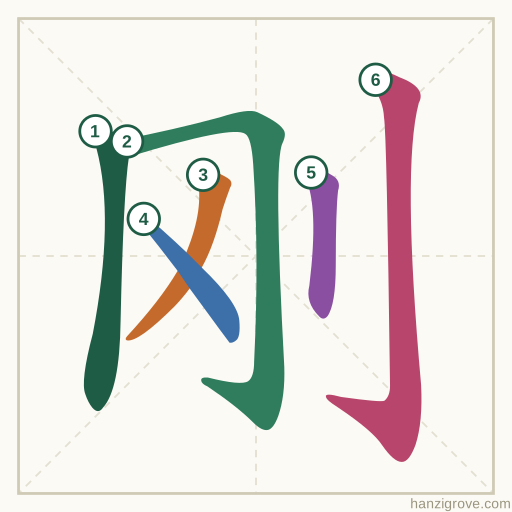
刚 (gāng) means “just”. It is made of 冈 + 刂 and has 6 strokes, and is an HSK 3 word in the current exam syllabus (2025).
Break 刚 into its parts
What 刚 is made of
- 冈 gāng — ridge or crest of hill
- 冂 — frame
- 丨 — vertical stroke
- 乂 yì — crossed strokes
- 丿 — falling stroke
- 冂 — frame
- 刂 dāo — knife
- 丨 — vertical stroke
- 亅 — hook
Origin hint: 刂 gives the meaning, 冈 gives the sound. (from the Make Me a Hanzi dataset; treat as a memory aid where history is uncertain)
刚 stroke order
Example sentences
我刚到家。Wǒ gāng dào jiā.I just got home.
钱刚够买一杯咖啡。Qián gāng gòu mǎi yī bēi kāfēi.The money is just enough for a cup of coffee.
Words with 刚
Also built with 冈
Quick facts
| Pinyin | gāng |
|---|---|
| Meaning | just; only just; exactly |
| Strokes | 6 |
| Radical | 刀 (knife, #18) |
| Pattern | Left–right |
| HSK | HSK 3 (exam 2025) · HSK 2 (2021) · Old HSK 4 |
Questions about 刚
What does 刚 mean?
刚 (gāng) means “just; only just; exactly”.
How many strokes does 刚 have?
刚 has 6 strokes.
What is the radical of 刚?
The radical of 刚 is 刀 (dāo, “knife”), Kangxi radical number 18.
What parts make up 刚?
刚 is made of 冈 (ridge or crest of hill) and 刂 (knife).
Which HSK level is 刚?
刚 is in HSK 3 (exam 2025) and HSK 2 (2021) and Old HSK 4.
Learn 刚 with its group
It is part of HSK 2 (2021) · Group 25: a short group with quick checks and spaced repeats.