
咸
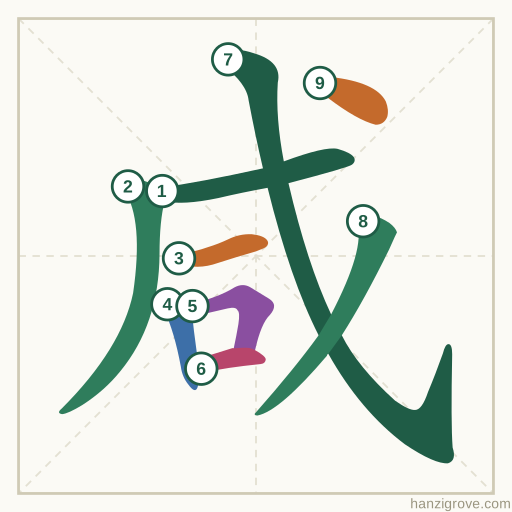
咸 (xián) means “salty”. It is made of 戊 + 一 + 口 and has 9 strokes, and is an HSK 4 word in the current exam syllabus (2025).
Break 咸 into its parts
What 咸 is made of
- 戊 wù — 5th heavenly stem
- 丿 — falling stroke
- 戈 gē — spear
- 一 — horizontal stroke
- 口 kǒu — mouth
- 冂 — frame
- 丨 — vertical stroke
- 一 — horizontal stroke
- 冂 — frame
Origin hint: One 一 voice 口 surrounded by conflict 戈 (from the Make Me a Hanzi dataset; treat as a memory aid where history is uncertain)
咸 stroke order
Example sentences
这个菜太咸了。Zhègè cài tài xián le.This dish is too salty.
汤有点儿咸,再加点儿水吧。Tāng yǒudiǎnr xián, zài jiā diǎnr shuǐ ba.The soup is a bit salty; add a little more water.
Also built with 戊
Quick facts
| Pinyin | xián |
|---|---|
| Meaning | salty |
| Strokes | 9 |
| Radical | 口 (mouth, #30) |
| Pattern | Open at the bottom |
| HSK | HSK 4 (exam 2025) · HSK 4 (2021) · Old HSK 4 |
Questions about 咸
What does 咸 mean?
咸 (xián) means “salty”.
How many strokes does 咸 have?
咸 has 9 strokes.
What is the radical of 咸?
The radical of 咸 is 口 (kǒu, “mouth”), Kangxi radical number 30.
What parts make up 咸?
咸 is made of 戊 (5th heavenly stem) and 一 (horizontal stroke) and 口 (mouth).
Which HSK level is 咸?
咸 is in HSK 4 (exam 2025) and HSK 4 (2021) and Old HSK 4.
Learn 咸 with its group
It is part of HSK 4 (2021) · Group 93: a short group with quick checks and spaced repeats.