
存
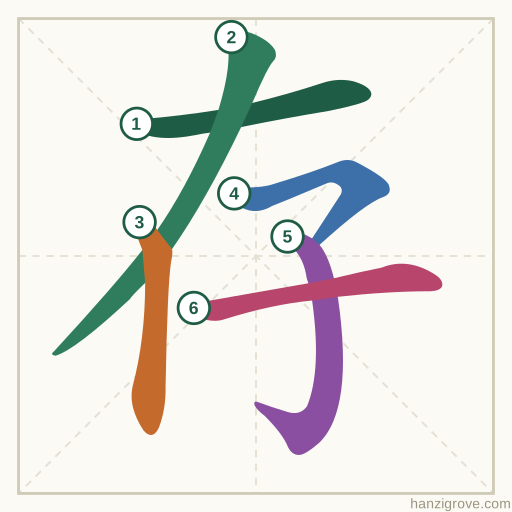
存 (cún) means “to save”. It is made of 才 + 子 and has 6 strokes, and is an HSK 4 word in the current exam syllabus (2025).
Break 存 into its parts
What 存 is made of
- 才 cái — ability
- 扌 shǒu — hand
- 二 — two strokes
- 亅 — hook
- 扌 shǒu — hand
- 子 zǐ — child
- 了 liǎo / le — finish
- 乛 — bent stroke
- 亅 — hook
- 一 — horizontal stroke
- 了 liǎo / le — finish
Origin hint: 子 gives the meaning, 才 gives the sound. (from the Make Me a Hanzi dataset; treat as a memory aid where history is uncertain)
存 stroke order
Example sentences
我想把钱存在银行。Wǒ xiǎng bǎ qián cún zài yínháng.I want to deposit my money in the bank.
你把照片存在电脑里了吗?Nǐ bǎ zhàopiàn cún zài diànnǎo lǐ le ma?Did you save the photos on the computer?
Words with 存
Also built with 才
Quick facts
| Pinyin | cún |
|---|---|
| Meaning | to save; to deposit; to store |
| Strokes | 6 |
| Radical | 子 (child, #39) |
| Pattern | Top-left wrap |
| HSK | HSK 4 (exam 2025) · HSK 3 (2021) · Old HSK 4 |
Questions about 存
What does 存 mean?
存 (cún) means “to save; to deposit; to store”.
How many strokes does 存 have?
存 has 6 strokes.
What is the radical of 存?
The radical of 存 is 子 (zi, “child”), Kangxi radical number 39.
What parts make up 存?
存 is made of 才 (ability) and 子 (child).
Which HSK level is 存?
存 is in HSK 4 (exam 2025) and HSK 3 (2021) and Old HSK 4.
Learn 存 with its group
It is part of HSK 3 (2021) · Group 23: a short group with quick checks and spaced repeats.