
带
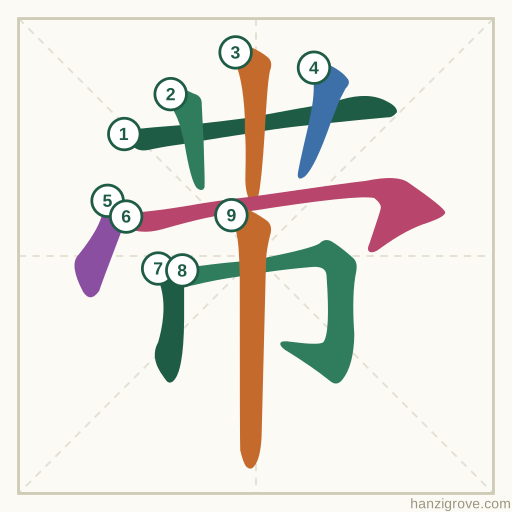
带 (dài) means “to bring”. It is made of 卅 + 冖 + 巾 and has 9 strokes, and is an HSK 3 word in the current exam syllabus (2025).
Break 带 into its parts
What 带 is made of
- 卅 sà — thirty
- 一 — horizontal stroke
- 川 chuān — stream
- 丿 — falling stroke
- 丨 — vertical stroke
- 丨 — vertical stroke
- 冖 mì — cover
- 巾 jīn — cloth
- 冂 — frame
- 丨 — vertical stroke
- 丨 — vertical stroke
- 冂 — frame
Origin hint: A belt, creasing one's robe above 卅 but not below 巾 (from the Make Me a Hanzi dataset; treat as a memory aid where history is uncertain)
带 stroke order
Example sentences
我没带手机。Wǒ méi dài shǒujī.I didn't bring my phone.
你带钱了吗?Nǐ dài qián le ma?Did you bring any money?
Words with 带
- 带来dàiláito bring
- 带动dàidòngto drive
- 带领dàilǐngto lead
- 系领带jì lǐngdàito tie a necktie
- 磁带cídàimagnetic tape
- 温带wēndàitemperate zone
- 携带xiédàito carry
Quick facts
| Pinyin | dài |
|---|---|
| Meaning | to bring; to take along; belt |
| Strokes | 9 |
| Radical | 巾 (turban, #50) |
| Pattern | Top–bottom |
| HSK | HSK 3 (exam 2025) · HSK 2 (2021) · Old HSK 3 |
Questions about 带
What does 带 mean?
带 (dài) means “to bring; to take along; belt”.
How many strokes does 带 have?
带 has 9 strokes.
What is the radical of 带?
The radical of 带 is 巾 (jīn, “turban”), Kangxi radical number 50.
What parts make up 带?
带 is made of 卅 (thirty) and 冖 (cover) and 巾 (cloth).
Which HSK level is 带?
带 is in HSK 3 (exam 2025) and HSK 2 (2021) and Old HSK 3.
Learn 带 with its group
It is part of HSK 2 (2021) · Group 23: a short group with quick checks and spaced repeats.