
归
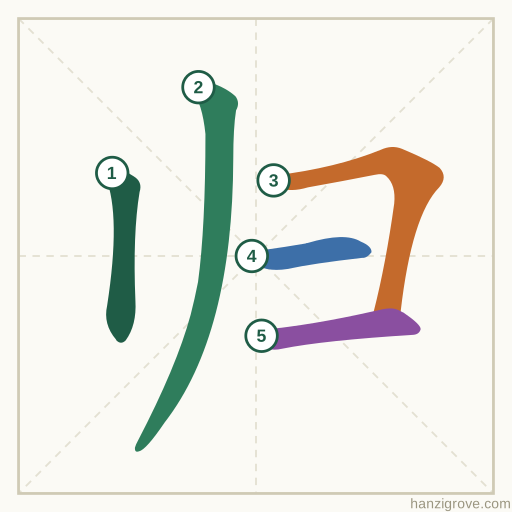
归 (guī) means “to return”. It is made of 彐 and has 5 strokes, and is an HSK 4 word in the 2021 standard.
Break 归 into its parts
What 归 is made of
- 彐 jì — snout
- 二 — two strokes
- 一 — horizontal stroke
- 一 — horizontal stroke
- 二 — two strokes
Origin hint: Simplified form of 歸; a wife 帚 returning home; 追 provides the pronunciation (from the Make Me a Hanzi dataset; treat as a memory aid where history is uncertain)
归 stroke order
Example sentences
这本书该归还图书馆了。Zhè běn shū gāi guī huán túshūguǎn le.It's time to return this book to the library.
这件事归谁负责?Zhè jiàn shì guī shéi fùzé?Who is responsible for this matter?
Words with 归
Also built with 彐
- 妇fùmarried woman
- 寻xúnto seek
- 当dāngto be
- 录lùto record
- 扫sǎoto sweep
- 灵língspirit
- 虐nüècruel
- 隶lìsubservient
- 雪xuěsnow
Quick facts
| Pinyin | guī |
|---|---|
| Meaning | to return; to belong to; to be up to |
| Strokes | 5 |
| Radical | 彐 (snout, #58) |
| Pattern | Left–right |
| HSK | HSK 4 (2021) |
Questions about 归
What does 归 mean?
归 (guī) means “to return; to belong to; to be up to”.
How many strokes does 归 have?
归 has 5 strokes.
What is the radical of 归?
The radical of 归 is 彐 (jì, “snout”), Kangxi radical number 58.
What parts make up 归?
归 is made of 彐 (snout).
Which HSK level is 归?
归 is in HSK 4 (2021).
Learn 归 with its group
It is part of HSK 4 (2021) · Group 96: a short group with quick checks and spaced repeats.