
感
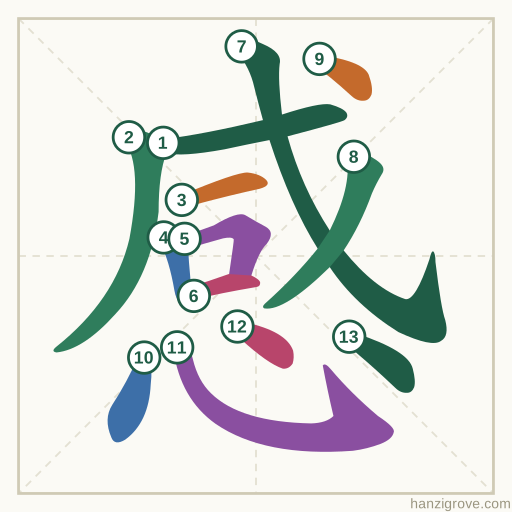
感 (gǎn) means “feeling”. It is made of 咸 + 心 and has 13 strokes, and is an HSK 4 word in the current exam syllabus (2025).
Break 感 into its parts
What 感 is made of
- 咸 xián — all
- 戊 wù — 5th heavenly stem
- 丿 — falling stroke
- 戈 gē — spear
- 一 — horizontal stroke
- 口 kǒu — mouth
- 冂 — frame
- 一 — horizontal stroke
- 戊 wù — 5th heavenly stem
- 心 xīn — heart
Origin hint: Two hearts 心 beating together 咸 (from the Make Me a Hanzi dataset; treat as a memory aid where history is uncertain)
感 stroke order
Example sentences
我对这个城市很有好感。Wǒ duì zhège chéngshì hěn yǒu hǎogǎn.I have a good impression of this city.
他是一个很有责任感的人。Tā shì yí ge hěn yǒu zérèngǎn de rén.He is a person with a strong sense of responsibility.
Words with 感
- 感到gǎndàoto feel
- 感动gǎndòngto move (emotionally)
- 感觉gǎnjuéto feel
- 感谢gǎnxièto thank
- 感冒gǎnmàoto catch a cold
- 感情gǎnqíngfeelings
- 感受gǎnshòuto feel
- 情感qínggǎnfeelings
- 感兴趣gǎn xìngqùto be interested (in)
- 感激gǎnjīto be grateful
- 感想gǎnxiǎngthoughts
- 敏感mǐngǎnsensitive
- 反感fǎngǎnto dislike
- 感慨gǎnkǎito sigh with emotion
- 感染gǎnrǎnto infect
- 灵感línggǎninspiration
- 性感xìnggǎnsexy
- 感人gǎnrénmoving
Also built with 咸
Quick facts
| Pinyin | gǎn |
|---|---|
| Meaning | feeling; sense; to feel |
| Strokes | 13 |
| Radical | 心 (heart, #61) |
| Pattern | Top–bottom |
| HSK | HSK 4 (exam 2025) |
Questions about 感
What does 感 mean?
感 (gǎn) means “feeling; sense; to feel”.
How many strokes does 感 have?
感 has 13 strokes.
What is the radical of 感?
The radical of 感 is 心 (xīn, “heart”), Kangxi radical number 61.
What parts make up 感?
感 is made of 咸 (all) and 心 (heart).
Which HSK level is 感?
感 is in HSK 4 (exam 2025).
Learn 感 with its group
It is part of HSK 4 · Group 23: a short group with quick checks and spaced repeats.