
拿
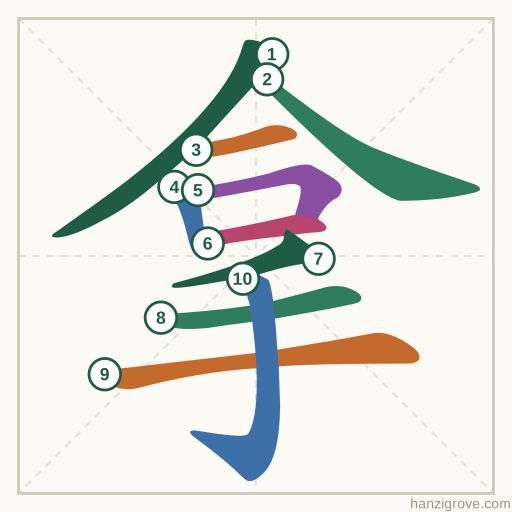
拿 (ná) means “to take”. It is made of 合 + 手 and has 10 strokes, and is an HSK 2 word in the current exam syllabus (2025).
Break 拿 into its parts
What 拿 is made of
- 合 hé — to combine
- 亼 jí — to assemble
- 人 rén — person
- 一 — horizontal stroke
- 口 kǒu — mouth
- 冂 — frame
- 一 — horizontal stroke
- 亼 jí — to assemble
- 手 shǒu — hand
Origin hint: 手 gives the meaning, 合 gives the sound. (from the Make Me a Hanzi dataset; treat as a memory aid where history is uncertain)
拿 stroke order
Example sentences
我来拿吧。Wǒ lái ná ba.Let me carry it.
你手里拿的是什么?Nǐ shǒulǐ ná de shì shénme?What are you holding in your hand?
Words with 拿
Also built with 合
- 哈hāha (laughter)
- 恰qiàjust
- 拾shíto pick up
- 洽qiàto mix
- 盒hésmall box or case
- 答dáto answer
- 给gěito give
- 鸽gēpigeon
Quick facts
| Pinyin | ná |
|---|---|
| Meaning | to take; to hold; to carry |
| Strokes | 10 |
| Radical | 手 (hand, #64) |
| Pattern | Top–bottom |
| HSK | HSK 2 (exam 2025) · HSK 1 (2021) · Old HSK 3 |
Questions about 拿
What does 拿 mean?
拿 (ná) means “to take; to hold; to carry”.
How many strokes does 拿 have?
拿 has 10 strokes.
What is the radical of 拿?
The radical of 拿 is 手 (shǒu, “hand”), Kangxi radical number 64.
What parts make up 拿?
拿 is made of 合 (to combine) and 手 (hand).
Which HSK level is 拿?
拿 is in HSK 2 (exam 2025) and HSK 1 (2021) and Old HSK 3.
Learn 拿 with its group
It is part of HSK 1 (2021) · Group 11: a short group with quick checks and spaced repeats.