
断
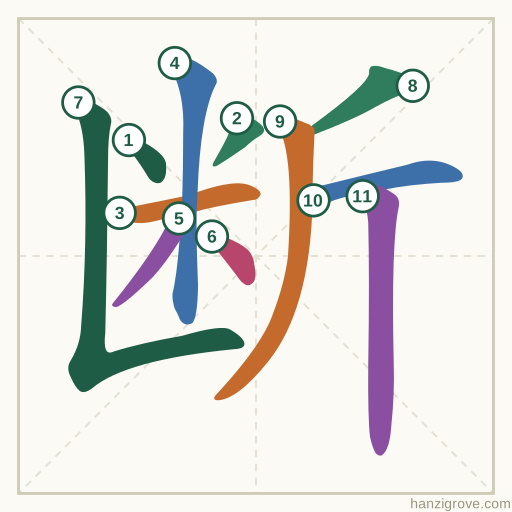
断 (duàn) means “to break”. It is made of 米 + 斤 and has 11 strokes, and is an HSK 3 word in the 2021 standard.
Break 断 into its parts
What 断 is made of
- 米 mǐ — uncooked rice
- 丷 ha — kwukyel
- 丶 — dot
- 木 mù — tree
- 十 — ten
- 八 bā — eight
- 丷 ha — kwukyel
- 斤 jīn — a catty (about 500 grams)
- 厂 chǎng — "cliff" in Chinese characters (Kangxi radical 27)
- 下 xià — below
Origin hint: Using an axe 斤 to harvest grain 米 (from the Make Me a Hanzi dataset; treat as a memory aid where history is uncertain)
断 stroke order
Example sentences
我的铅笔又断了。Wǒ de qiānbǐ yòu duàn le.My pencil broke again.
电话怎么断了?Diànhuà zěnme duàn le?Why did the call get cut off?
Words with 断
- 不断bùduàncontinuously
- 判断pànduànto judge
- 诊断zhěnduànto diagnose
- 断定duàndìngto conclude
- 断绝duànjuéto cut off
- 果断guǒduàndecisive
- 垄断lǒngduànto monopolize
- 片断piànduànfragment
- 中断zhōngduànto break off
Also built with ⿺
Quick facts
| Pinyin | duàn |
|---|---|
| Meaning | to break; to cut off |
| Strokes | 11 |
| Radical | 斤 (axe, #69) |
| Pattern | Left–right |
| HSK | HSK 3 (2021) · Old HSK 5 |
Questions about 断
What does 断 mean?
断 (duàn) means “to break; to cut off”.
How many strokes does 断 have?
断 has 11 strokes.
What is the radical of 断?
The radical of 断 is 斤 (jīn, “axe”), Kangxi radical number 69.
What parts make up 断?
断 is made of 米 (uncooked rice) and 斤 (a catty (about 500 grams)).
Which HSK level is 断?
断 is in HSK 3 (2021) and Old HSK 5.
Learn 断 with its group
It is part of HSK 3 (2021) · Group 66: a short group with quick checks and spaced repeats.