
死
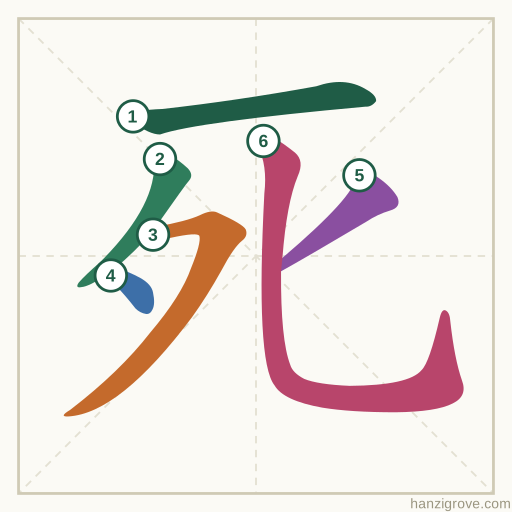
死 (sǐ) means “to die”. It is made of 歹 + 匕 and has 6 strokes, and is an HSK 4 word in the current exam syllabus (2025).
Break 死 into its parts
What 死 is made of
- 歹 dǎi — corpse
- 一 — horizontal stroke
- 夕 xī — evening
- 勹 bāo — wrap shape
- 丶 — dot
- 匕 bǐ — spoon
- 乚 — hook stroke
- 丿 — falling stroke
Origin hint: A person kneeling 匕 before a corpse 歹 (from the Make Me a Hanzi dataset; treat as a memory aid where history is uncertain)
死 stroke order
Example sentences
我忘了给花喝水,花都死了。Wǒ wàng le gěi huā hē shuǐ, huā dōu sǐ le.I forgot to water the flowers, and they all died.
今天真是热死了!Jīntiān zhēn shì rè sǐ le!It's so hot today!
Words with 死
Also built with 歹
Quick facts
| Pinyin | sǐ |
|---|---|
| Meaning | to die; dead; extremely (…死了) |
| Strokes | 6 |
| Radical | 歹 (death, #78) |
| Pattern | Top-left wrap |
| HSK | HSK 4 (exam 2025) · HSK 3 (2021) · Old HSK 4 |
Questions about 死
What does 死 mean?
死 (sǐ) means “to die; dead; extremely (…死了)”.
How many strokes does 死 have?
死 has 6 strokes.
What is the radical of 死?
The radical of 死 is 歹 (dǎi, “death”), Kangxi radical number 78.
What parts make up 死?
死 is made of 歹 (corpse) and 匕 (spoon).
Which HSK level is 死?
死 is in HSK 4 (exam 2025) and HSK 3 (2021) and Old HSK 4.
Learn 死 with its group
It is part of HSK 3 (2021) · Group 2: a short group with quick checks and spaced repeats.