
爬
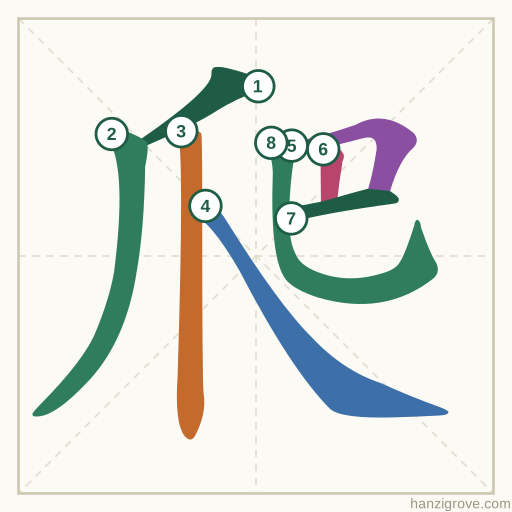
爬 (pá) means “to climb”. It is made of 爪 + 巴 and has 8 strokes, and is an HSK 3 word in the current exam syllabus (2025).
Break 爬 into its parts
What 爬 is made of
- 爪 zhǎo — claws
- 丨 — vertical stroke
- 巴 bā — to desire
- 巳 sì — the hours from 9 to 11
- 乚 — hook stroke
- 巳 sì — the hours from 9 to 11
Origin hint: 爪 gives the meaning, 巴 gives the sound. (from the Make Me a Hanzi dataset; treat as a memory aid where history is uncertain)
爬 stroke order
Example sentences
孩子在地上爬。Háizi zài dìshàng pá.The child is crawling on the floor.
猫爬到树上了。Māo pá dào shù shàng le.The cat climbed up the tree.
Words with 爬
Also built with 爪
Quick facts
| Pinyin | pá |
|---|---|
| Meaning | to climb; to crawl |
| Strokes | 8 |
| Radical | 爪 (claw, #87) |
| Pattern | Bottom-left wrap |
| HSK | HSK 3 (exam 2025) · HSK 2 (2021) |
Questions about 爬
What does 爬 mean?
爬 (pá) means “to climb; to crawl”.
How many strokes does 爬 have?
爬 has 8 strokes.
What is the radical of 爬?
The radical of 爬 is 爪 (zhǎo, “claw”), Kangxi radical number 87.
What parts make up 爬?
爬 is made of 爪 (claws) and 巴 (to desire).
Which HSK level is 爬?
爬 is in HSK 3 (exam 2025) and HSK 2 (2021).
Learn 爬 with its group
It is part of HSK 2 (2021) · Group 14: a short group with quick checks and spaced repeats.