
登
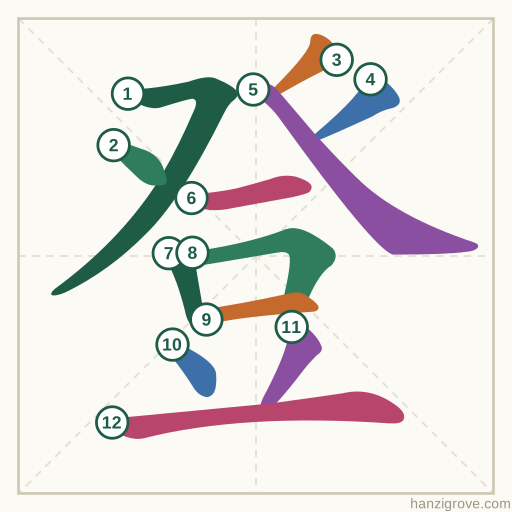
登 (dēng) means “to climb”. It is made of 癶 + 豆 and has 12 strokes, and is an HSK 4 word in the 2021 standard.
Break 登 into its parts
What 登 is made of
- 癶 bō — legs
- 豆 dòu — beans
- 一 — horizontal stroke
- 口 kǒu — mouth
- 冂 — frame
- 一 — horizontal stroke
- 丷 ha — kwukyel
- 丶 — dot
- 一 — horizontal stroke
Origin hint: 癶 gives the meaning, 豆 gives the sound. (from the Make Me a Hanzi dataset; treat as a memory aid where history is uncertain)
登 stroke order
Example sentences
我们登上了山顶。Wǒmen dēng shang le shāndǐng.We climbed to the top of the mountain.
你登过长城吗?Nǐ dēng guo Chángchéng ma?Have you ever climbed the Great Wall?
Words with 登
- 登记dēngjìto register
- 登录dēnglùto log in
- 登山dēngshānmountain climbing
- 登机牌dēngjīpáiboarding pass
- 登陆dēnglùto land
- 刊登kāndēngto publish (in a newspaper or magazine)
- 攀登pāndēngto climb
- 登机dēngjīto board a plane
Quick facts
| Pinyin | dēng |
|---|---|
| Meaning | to climb; to go up; to publish |
| Strokes | 12 |
| Radical | 癶 (footsteps, #105) |
| Pattern | Top–bottom |
| HSK | HSK 4 (2021) |
Questions about 登
What does 登 mean?
登 (dēng) means “to climb; to go up; to publish”.
How many strokes does 登 have?
登 has 12 strokes.
What is the radical of 登?
The radical of 登 is 癶 (bō, “footsteps”), Kangxi radical number 105.
What parts make up 登?
登 is made of 癶 (legs) and 豆 (beans).
Which HSK level is 登?
登 is in HSK 4 (2021).
Learn 登 with its group
It is part of HSK 4 (2021) · Group 74: a short group with quick checks and spaced repeats.