
笨
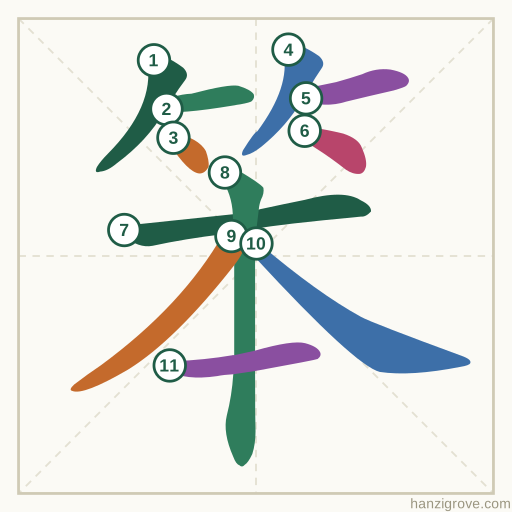
笨 (bèn) means “stupid”. It is made of ⺮ + 本 and has 11 strokes, and is an HSK 4 word in the current exam syllabus (2025).
Break 笨 into its parts
What 笨 is made of
- ⺮ zhú — bamboo
- 本 běn — root
- 木 mù — tree
- 十 — ten
- 八 bā — eight
- 一 — horizontal stroke
- 木 mù — tree
Origin hint: ⺮ gives the meaning, 本 gives the sound. (from the Make Me a Hanzi dataset; treat as a memory aid where history is uncertain)
笨 stroke order
Example sentences
我太笨了,又忘了带钥匙。Wǒ tài bèn le, yòu wàng le dài yàoshi.I'm so silly; I forgot my keys again.
他不笨,只是不认真。Tā bù bèn, zhǐshì bù rènzhēn.He isn't stupid, just careless.
Words with 笨
Also built with ⺮
- 笑xiàoto smile
- 笔bǐpen
- 符fúamulet
- 第dìordinal prefix (first, second…)
- 笼lóngbasket
- 等děngto wait
- 筋jīnmuscles
- 筐kuāngbasket
- 筑zhùbuilding
- 筒tǒngtube
- 答dáto answer
- 策cèto urge
Quick facts
| Pinyin | bèn |
|---|---|
| Meaning | stupid; foolish; clumsy |
| Strokes | 11 |
| Radical | 竹 (bamboo, #118) |
| Pattern | Top–bottom |
| HSK | HSK 4 (exam 2025) · HSK 4 (2021) · Old HSK 4 |
Questions about 笨
What does 笨 mean?
笨 (bèn) means “stupid; foolish; clumsy”.
How many strokes does 笨 have?
笨 has 11 strokes.
What is the radical of 笨?
The radical of 笨 is 竹 (zhú, “bamboo”), Kangxi radical number 118.
What parts make up 笨?
笨 is made of ⺮ (bamboo) and 本 (root).
Which HSK level is 笨?
笨 is in HSK 4 (exam 2025) and HSK 4 (2021) and Old HSK 4.
Learn 笨 with its group
It is part of HSK 4 (2021) · Group 35: a short group with quick checks and spaced repeats.