
累
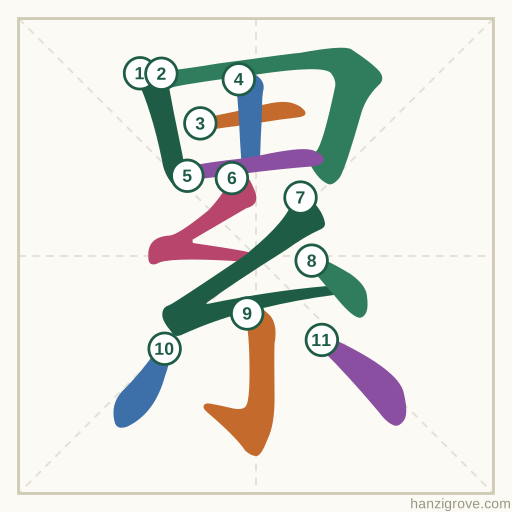
累 (lèi) means “tired”. It is made of 田 + 糸 and has 11 strokes, and is an HSK 2 word in the current exam syllabus (2025).
Break 累 into its parts
What 累 is made of
- 田 tián — field
- 冂 — frame
- 丨 — vertical stroke
- 土 tǔ — earth
- 十 — ten
- 一 — horizontal stroke
- 冂 — frame
- 糸 mì — silk
- 幺 yāo — one
- 小 xiǎo — small
- 亅 — hook
- 八 bā — eight
Origin hint: Simplified form of 纍; growing silk 糸 in the fields 畾; 畾 also provides the pronunciation (from the Make Me a Hanzi dataset; treat as a memory aid where history is uncertain)
累 stroke order
Example sentences
我今天很累。Wǒ jīntiān hěn lèi.I'm very tired today.
你累不累?Nǐ lèi bù lèi?Are you tired?
Words with 累
Also built with 田
- 备bèito prepare
- 奋fènto strive
- 思sīto think
- 果guǒfruit
- 男nánmale
- 界jièboundary
- 畏wèifear
- 畔pànside
- 留liúto leave (behind)
- 畜chùlivestock
- 略lüèapproximate
- 番fāna time
Quick facts
| Pinyin | lèi |
|---|---|
| Meaning | tired |
| Strokes | 11 |
| Radical | 糸 (silk, #120) |
| Pattern | Top–bottom |
| HSK | HSK 2 (exam 2025) · HSK 1 (2021) · Old HSK 2 |
Questions about 累
What does 累 mean?
累 (lèi) means “tired”.
How many strokes does 累 have?
累 has 11 strokes.
What is the radical of 累?
The radical of 累 is 糸 (mì, “silk”), Kangxi radical number 120.
What parts make up 累?
累 is made of 田 (field) and 糸 (silk).
Which HSK level is 累?
累 is in HSK 2 (exam 2025) and HSK 1 (2021) and Old HSK 2.
Learn 累 with its group
It is part of HSK 1 (2021) · Group 20: a short group with quick checks and spaced repeats.