
编
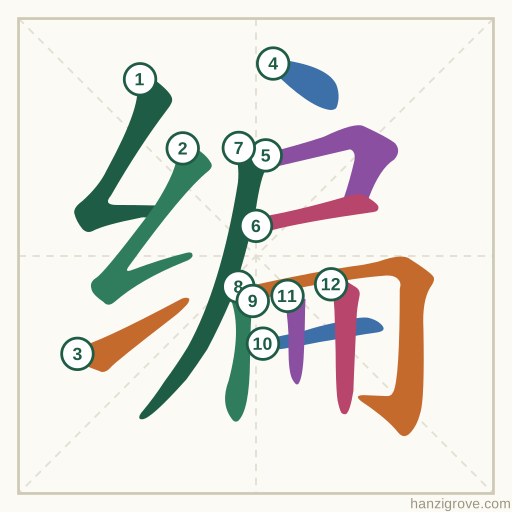
编 (biān) means “to weave”. It is made of 纟 + 扁 and has 12 strokes, and is an HSK 4 word in the 2021 standard.
Break 编 into its parts
What 编 is made of
- 纟 sī — silk
- 一 — horizontal stroke
- 扁 biǎn — flat
- 户 hù — a household
- 丶 — dot
- 尸 shī — body
- 户 hù — a household
Origin hint: 纟 gives the meaning, 扁 gives the sound. (from the Make Me a Hanzi dataset; treat as a memory aid where history is uncertain)
编 stroke order
Example sentences
奶奶在编一个篮子。Nǎinai zài biān yī gè lánzi.Grandma is weaving a basket.
老师把我们编成了三个组。Lǎoshī bǎ wǒmen biān chéng le sān gè zǔ.The teacher organized us into three groups.
Words with 编
Also built with 纟
- 纠jiūtangled
- 红hóngred
- 纤xiānfine
- 约yuēto arrange to meet
- 级jílevel
- 纪jìdiscipline
- 纬wěiwarp and woof
- 纯chúnpure
- 纲gāngprogram
- 纳nàto adopt
- 纵zòngto indulge in
- 纷fēntangled
Quick facts
| Pinyin | biān |
|---|---|
| Meaning | to weave; to organize; to compile |
| Strokes | 12 |
| Radical | 糸 (silk, #120) |
| Pattern | Left–right |
| HSK | HSK 4 (2021) |
Questions about 编
What does 编 mean?
编 (biān) means “to weave; to organize; to compile”.
How many strokes does 编 have?
编 has 12 strokes.
What is the radical of 编?
The radical of 编 is 糸 (mì, “silk”), Kangxi radical number 120.
What parts make up 编?
编 is made of 纟 (silk) and 扁 (flat).
Which HSK level is 编?
编 is in HSK 4 (2021).
Learn 编 with its group
It is part of HSK 4 (2021) · Group 41: a short group with quick checks and spaced repeats.