
胸
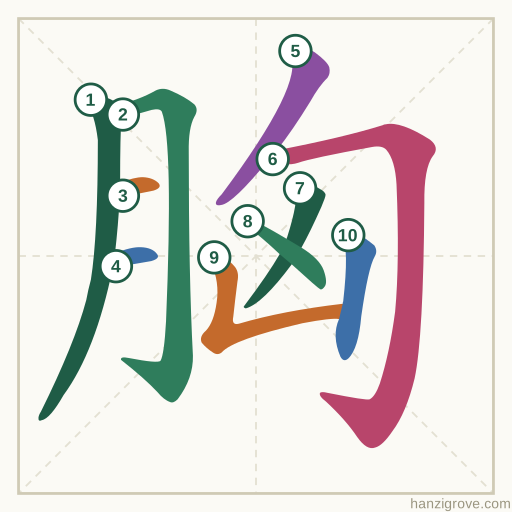
胸 (xiōng) means “chest”. It is made of ⺼ + 匈 and has 10 strokes, and is an old HSK 5 word (HSK 2.0).
Break 胸 into its parts
What 胸 is made of
- ⺼ — meat
- 匈 xiōng — breast
- 勹 bāo — wrap shape
- 丿 — falling stroke
- 凶 xiōng — culprit
- 凵 qiǎn — container
- 乂 yì — crossed strokes
- 勹 bāo — wrap shape
Origin hint: A heart ⺼ in the chest 匈; 匈 also provides the pronunciation (from the Make Me a Hanzi dataset; treat as a memory aid where history is uncertain)
胸 stroke order
Example sentences
他挺起胸,走上台。Tā tǐng qǐ xiōng, zǒu shàng tái.He stuck out his chest and walked onto the stage.
跑完步,我胸口有点儿疼。Pǎo wán bù, wǒ xiōngkǒu yǒudiǎnr téng.After running, my chest hurts a bit.
Words with 胸
Also built with ⺼
- 肌jīflesh
- 肖xiàoto resemble
- 肚dùbelly
- 肠chángintestines
- 股gǔshare
- 肢zhīlimbs
- 肤fūskin
- 肥féifatty
- 肩jiānshoulders
- 肪fánganimal fat
- 肯kěnto agree to
- 育yùto produce
Quick facts
| Pinyin | xiōng |
|---|---|
| Meaning | chest |
| Strokes | 10 |
| Radical | 肉 (meat; flesh, #130) |
| Pattern | Left–right |
| HSK | Old HSK 5 |
Questions about 胸
What does 胸 mean?
胸 (xiōng) means “chest”.
How many strokes does 胸 have?
胸 has 10 strokes.
What is the radical of 胸?
The radical of 胸 is 肉 (ròu, “meat; flesh”), Kangxi radical number 130.
What parts make up 胸?
胸 is made of ⺼ (meat) and 匈 (breast).
Which HSK level is 胸?
胸 is in Old HSK 5.
Learn 胸 with its group
It is part of Old HSK 5 · Group 108: a short group with quick checks and spaced repeats.