
脏
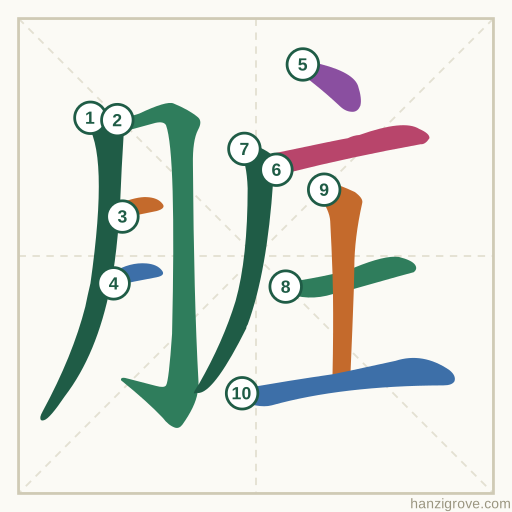
脏 (zāng) means “dirty”. It is made of ⺼ + 庄 and has 10 strokes, and is an HSK 3 word in the current exam syllabus (2025).
Break 脏 into its parts
What 脏 is made of
- ⺼ — meat
- 庄 zhuāng — village
- 广 guǎng — broad
- 丶 — dot
- 厂 chǎng — cliff
- 土 tǔ — earth
- 十 — ten
- 一 — horizontal stroke
- 广 guǎng — broad
Origin hint: ⺼ gives the meaning, 庄 gives the sound. (from the Make Me a Hanzi dataset; treat as a memory aid where history is uncertain)
脏 stroke order
Example sentences
你的手很脏,去洗洗。Nǐ de shǒu hěn zāng, qù xǐxi.Your hands are dirty; go wash them.
衣服脏了,快洗一下吧。Yīfu zāng le, kuài xǐ yīxià ba.The clothes are dirty; wash them quickly.
Words with 脏
Also built with ⺼
- 肌jīflesh
- 肖xiàoto resemble
- 肚dùbelly
- 肠chángintestines
- 股gǔshare
- 肢zhīlimbs
- 肤fūskin
- 肥féifatty
- 肩jiānshoulders
- 肪fánganimal fat
- 肯kěnto agree to
- 育yùto produce
Quick facts
| Pinyin | zāng |
|---|---|
| Meaning | dirty |
| Strokes | 10 |
| Radical | 肉 (meat; flesh, #130) |
| Pattern | Left–right |
| HSK | HSK 3 (exam 2025) · HSK 2 (2021) · Old HSK 4 |
Questions about 脏
What does 脏 mean?
脏 (zāng) means “dirty”.
How many strokes does 脏 have?
脏 has 10 strokes.
What is the radical of 脏?
The radical of 脏 is 肉 (ròu, “meat; flesh”), Kangxi radical number 130.
What parts make up 脏?
脏 is made of ⺼ (meat) and 庄 (village).
Which HSK level is 脏?
脏 is in HSK 3 (exam 2025) and HSK 2 (2021) and Old HSK 4.
Learn 脏 with its group
It is part of HSK 2 (2021) · Group 3: a short group with quick checks and spaced repeats.