
逃
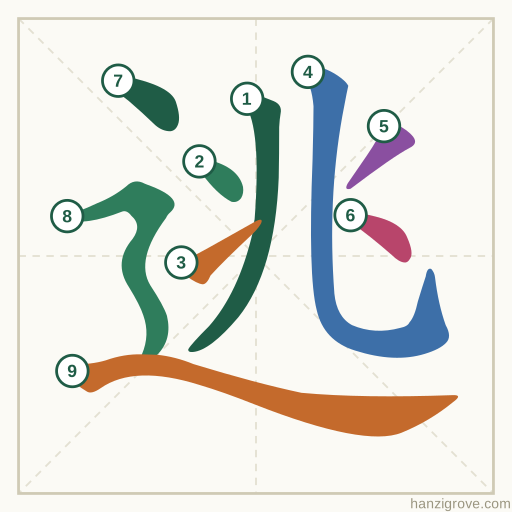
逃 (táo) means “to escape”. It is made of 辶 + 兆 and has 9 strokes, and is an old HSK 5 word (HSK 2.0).
Break 逃 into its parts
What 逃 is made of
- 辶 — walking, moving
- 兆 zhào — omen
- 儿 ér — child
- 丿 — falling stroke
- 乚 — hook stroke
- 儿 ér — child
逃 stroke order
Example sentences
小狗从家里逃了出去。Xiǎo gǒu cóng jiālǐ táo le chūqu.The puppy ran away from home.
遇到困难不能逃。Yùdào kùnnan bù néng táo.You can't run away when facing difficulties.
Words with 逃
Also built with 辶
- 巡xúnto cruise
- 边biānside
- 辽liáodistant
- 达dáto reach
- 迁qiānto shift
- 迄qìto extend
- 迅xùnquick
- 过guòto pass
- 迈màito step
- 迎yíngto welcome
- 运yùnto run
- 近jìnnear
Quick facts
| Pinyin | táo |
|---|---|
| Meaning | to escape; to run away |
| Strokes | 9 |
| Pattern | Bottom-left wrap |
| HSK | Old HSK 5 |
Questions about 逃
What does 逃 mean?
逃 (táo) means “to escape; to run away”.
How many strokes does 逃 have?
逃 has 9 strokes.
What parts make up 逃?
逃 is made of 辶 (walking, moving) and 兆 (omen).
Which HSK level is 逃?
逃 is in Old HSK 5.
Learn 逃 with its group
It is part of Old HSK 5 · Group 92: a short group with quick checks and spaced repeats.