
错
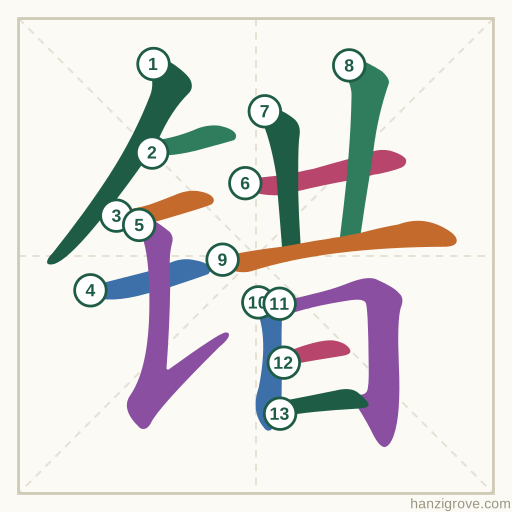
错 (cuò) means “wrong”. It is made of 钅 + 昔 and has 13 strokes, and is an HSK 2 word in the current exam syllabus (2025).
Break 错 into its parts
What 错 is made of
- 钅 jīn — metal
- 昔 xī — past
- 廿 niàn — twenty
- 廾 gǒng — two hands
- 一 — horizontal stroke
- 日 rì — sun; day
- 口 kǒu — mouth
- 一 — horizontal stroke
- 廿 niàn — twenty
Origin hint: Gold 钅 that once was 昔 but is lost (from the Make Me a Hanzi dataset; treat as a memory aid where history is uncertain)
错 stroke order
Example sentences
对不起,是我错了。Duìbuqǐ, shì wǒ cuò le.Sorry, it was my mistake.
这个字写错了。Zhège zì xiě cuò le.This character was written wrong.
Words with 错
Also built with 钅
- 衔xiánrank
- 针zhēnneedle
- 钉dīngnail
- 钓diàoto fish (with a line)
- 钙gàicalcium
- 钝dùnblunt
- 钞chāobank note
- 钟zhōngclock
- 钢gāngsteel
- 钥yàolock
- 钦qīnto respect
- 钩gōuhook
Quick facts
| Pinyin | cuò |
|---|---|
| Meaning | wrong; mistake |
| Strokes | 13 |
| Radical | 金 (gold, #167) |
| Pattern | Left–right |
| HSK | HSK 2 (exam 2025) · HSK 1 (2021) · Old HSK 2 |
Questions about 错
What does 错 mean?
错 (cuò) means “wrong; mistake”.
How many strokes does 错 have?
错 has 13 strokes.
What is the radical of 错?
The radical of 错 is 金 (jīn, “gold”), Kangxi radical number 167.
What parts make up 错?
错 is made of 钅 (metal) and 昔 (past).
Which HSK level is 错?
错 is in HSK 2 (exam 2025) and HSK 1 (2021) and Old HSK 2.
Learn 错 with its group
It is part of HSK 1 (2021) · Group 16: a short group with quick checks and spaced repeats.