
饿
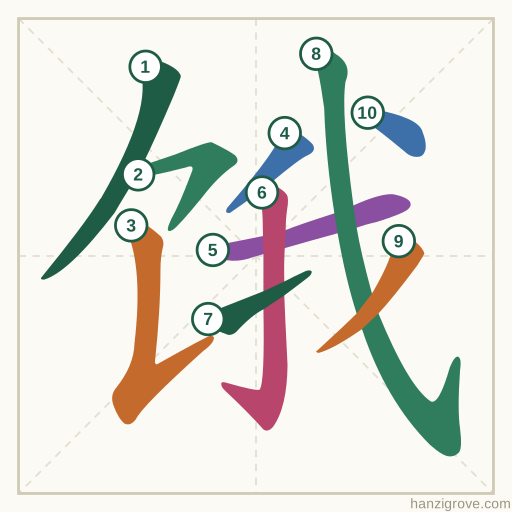
饿 (è) means “hungry”. It is made of 饣 + 我 and has 10 strokes, and is an HSK 3 word in the current exam syllabus (2025).
Break 饿 into its parts
What 饿 is made of
- 饣 shí — food
- 乚 — hook stroke
- 我 wǒ — I
- 扌 shǒu — hand
- 二 — two strokes
- 亅 — hook
- 戈 gē — spear
- 扌 shǒu — hand
Origin hint: To want 我 food 饣; 我 also provides the pronunciation (from the Make Me a Hanzi dataset; treat as a memory aid where history is uncertain)
饿 stroke order
Example sentences
我还没吃饭,很饿。Wǒ hái méi chīfàn, hěn è.I haven't eaten yet, I'm very hungry.
你饿不饿?Nǐ è bù è?Are you hungry?
Words with 饿
Also built with 饣
- 蚀shíto nibble at
- 饥jīhungry
- 饪rèncooked food
- 饭fànmeal
- 饮yǐnto swallow
- 饰shìto decorate
- 饱bǎofull (after eating)
- 饲sìto raise animals
- 饶ráoabundant
- 饺jiǎostuffed dumplings
- 饼bǐngrice-cake
- 馅xiànfilling
Quick facts
| Pinyin | è |
|---|---|
| Meaning | hungry |
| Strokes | 10 |
| Radical | 食 (eat, #184) |
| Pattern | Left–right |
| HSK | HSK 3 (exam 2025) · HSK 1 (2021) · Old HSK 3 |
Questions about 饿
What does 饿 mean?
饿 (è) means “hungry”.
How many strokes does 饿 have?
饿 has 10 strokes.
What is the radical of 饿?
The radical of 饿 is 食 (shí, “eat”), Kangxi radical number 184.
What parts make up 饿?
饿 is made of 饣 (food) and 我 (I).
Which HSK level is 饿?
饿 is in HSK 3 (exam 2025) and HSK 1 (2021) and Old HSK 3.
Learn 饿 with its group
It is part of HSK 1 (2021) · Group 49: a short group with quick checks and spaced repeats.