
Chinese character for tree: 树 (shù)
The Chinese character for tree is 树 (shù). It is the everyday word for a tree, as in 大树 (dàshù, big tree) and 树林 (shùlín, woods). The simpler character 木 (mù) means wood and is used in compounds.
How 树 is built
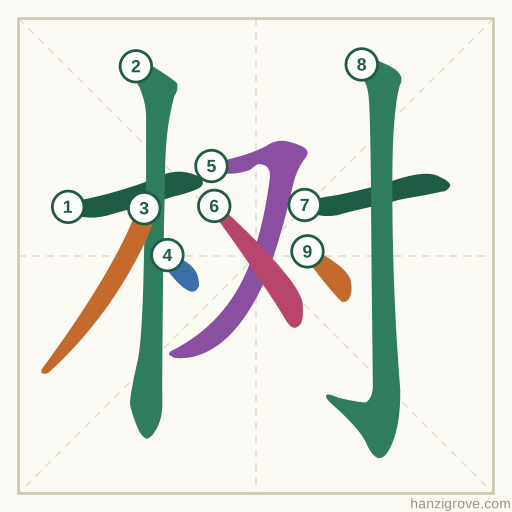
树 joins 木 (mù), the tree radical, with 对 (duì), which in the simplified form stands in for the sound. The traditional form 樹 has 木 with 尌, an older part that also gives the sound. The 木 radical itself is a picture of a tree with branches and roots. As a memory aid, a tree 木 standing opposite 对 another tree. It is the usual word in speech.
树 shù · tree
- 木mù — tree
- 十 — ten
- 一 — horizontal stroke
- 丨 — vertical stroke
- 八bā — eight
- 十 — ten
- 对duì — correct
- 又yòu — and
- 寸cùn — inch
Origin hint: 木 gives the meaning, 对 gives the sound. (from the Make Me a Hanzi dataset; treat as a memory aid where history is uncertain)
How 树 is used
Other ways to say tree
- 木 mù — wood, tree as a material or element
Before you use it as a tattoo or design: Simplified 树 and traditional 樹 differ a lot; the simpler pictograph 木 is a popular tattoo alternative.
Questions
What is the Chinese character for tree?
树 (shù) means “tree”. In traditional characters it is written 樹.
How do you pronounce 树?
树 is pronounced shù.
Is 树 simplified or traditional?
树 is the simplified form used in mainland China and Singapore; 樹 is the traditional form used in Taiwan and Hong Kong.