
Chinese character for virtue: 德 (dé)
The Chinese character for virtue is 德 (dé). It means virtue, moral character and goodness, and appears in 道德 (dàodé, morality) and 美德 (měidé, virtue). It is a central idea in Chinese philosophy.
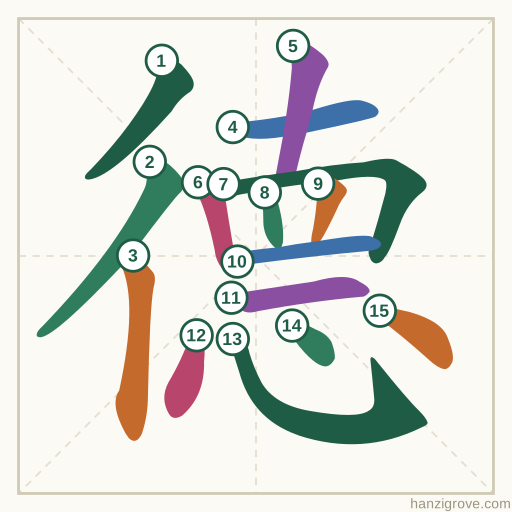
How 德 is built
德 has 彳 on the left, a step or road, which suggests conduct or the way you walk through life. On the right are 十, an eye 罒, a horizontal line and 心 (heart). Read as a memory aid: walking your path with a straight eye and an upright heart. Older forms show an eye looking straight ahead on a road. 德 is the same in simplified and traditional Chinese.
德 dé · ethics
- 彳chì — to step with the left foot
- 丨 — vertical stroke
- 十 — ten
- 一 — horizontal stroke
- 丨 — vertical stroke
- 罒wǎng — net
- 口kǒu — mouth
- 冂 — frame
- 一 — horizontal stroke
- 口kǒu — mouth
- 一 — horizontal stroke
- 心xīn — heart
How 德 is used
Other ways to say virtue
- 美德 měidé — a virtue, a good quality
Before you use it as a tattoo or design: 德 is identical in both scripts; in careful handwriting the right side has a horizontal line over 心, which artists sometimes miss.
Questions
What is the Chinese character for virtue?
德 (dé) means “virtue”.
How do you pronounce 德?
德 is pronounced dé.