
假
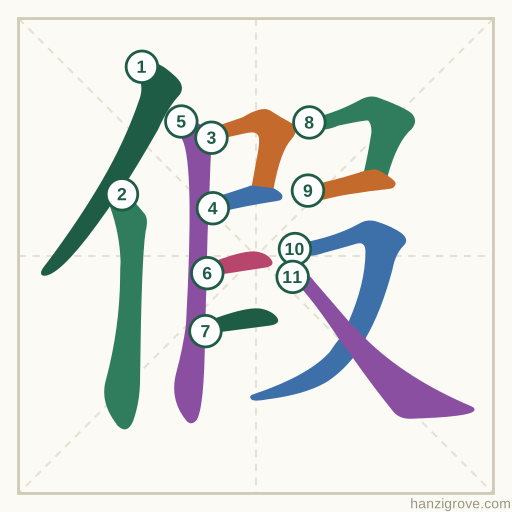
假 (jiǎ) means “fake”. It is made of 亻 + 叚 and has 11 strokes, and is an HSK 4 word in the current exam syllabus (2025).
Break 假 into its parts
What 假 is made of
- 亻 rén — person
- 叚 jiǎ — false
- 又 yòu — and
Origin hint: A false 叚 person 亻; 叚 also provides the pronunciation (from the Make Me a Hanzi dataset; treat as a memory aid where history is uncertain)
假 stroke order
Example sentences
这个包是假的。Zhège bāo shì jiǎ de.This bag is fake.
这些花是真的还是假的?Zhèxiē huā shì zhēnde háishì jiǎ de?Are these flowers real or fake?
Words with 假
- 放假fàngjiàto have a holiday
- 请假qǐngjiàto ask for leave
- 假期jiàqīholiday
- 休假xiūjiàto take a vacation
- 寒假hánjiàwinter vacation
- 假如jiǎrúif
- 暑假shǔjiàsummer vacation
- 放暑假fàng shǔjiàto have summer vacation
- 假设jiǎshèto suppose
- 假装jiǎzhuāngto pretend
- 虚假xūjiǎfalse
- 度假dùjiàto go on vacation
- 假日jiàrìholiday
- 节假日jiéjiàrìpublic holidays
Also built with 亻
- 亿yìhundred million
- 什shénwhat? mixed
- 仁rénbenevolent
- 仅jǐnonly
- 仇chóuenemy
- 仍réngstill
- 仔zǐsmall thing
- 他tāhe
- 仗zhàng1to rely upon
- 付fùto pay
- 仙xiāngod
- 代dàion behalf of
Quick facts
| Pinyin | jiǎ |
|---|---|
| Meaning | fake; false |
| Strokes | 11 |
| Radical | 人 (person, #9) |
| Pattern | Left–right |
| HSK | HSK 4 (exam 2025) · HSK 2 (2021) · Old HSK 4 |
Questions about 假
What does 假 mean?
假 (jiǎ) means “fake; false”.
How many strokes does 假 have?
假 has 11 strokes.
What is the radical of 假?
The radical of 假 is 人 (rén, “person”), Kangxi radical number 9.
What parts make up 假?
假 is made of 亻 (person) and 叚 (false).
Which HSK level is 假?
假 is in HSK 4 (exam 2025) and HSK 2 (2021) and Old HSK 4.
Learn 假 with its group
It is part of HSK 2 (2021) · Group 26: a short group with quick checks and spaced repeats.