
可
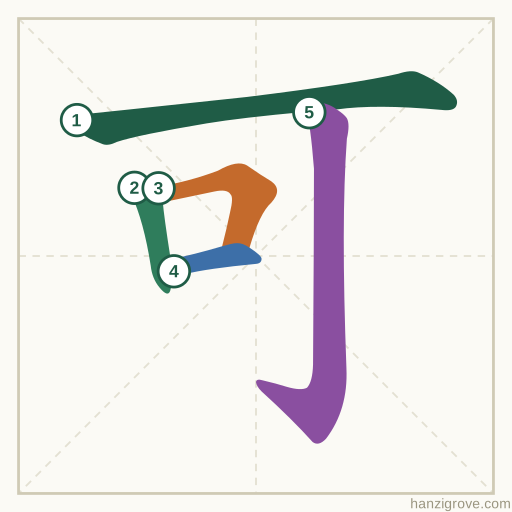
可 (kě) means “but”. It is made of 丁 + 口 and has 5 strokes, and is an HSK 3 word in the current exam syllabus (2025).
Break 可 into its parts
What 可 is made of
- 丁 dīng — male adult
- 口 kǒu — mouth
- 冂 — frame
- 丨 — vertical stroke
- 一 — horizontal stroke
- 冂 — frame
Origin hint: 丁 gives the meaning, 口 gives the sound. (from the Make Me a Hanzi dataset; treat as a memory aid where history is uncertain)
可 stroke order
Example sentences
这个菜可好吃了!Zhège cài kě hǎochī le!This dish is really delicious!
我想去,可我没有时间。Wǒ xiǎng qù, kě wǒ méiyǒu shíjiān.I want to go, but I don't have time.
Words with 可
- 可爱kě'àicute
- 可能kěnéngmaybe
- 可怕kěpàscary
- 可是kěshìbut
- 可以kěyǐcan
- 可靠kěkàoreliable
- 可乐kělècola
- 认可rènkěto approve
- 可见kějiànit is clear that
- 可怜kěliánpitiful
- 可惜kěxīit's a pity
- 宁可nìngkěwould rather
- 不可思议bùkěsīyìunbelievable
- 可观kěguānconsiderable
- 可口kěkǒutasty
- 可恶kěwùhateful
- 可行kěxíngfeasible
- 难能可贵nánnéngkěguìrare and commendable
- 许可xǔkěto permit
Also built with 丁
- 予yǔto give
- 亭tíngpavilion
- 厅tīnghall
- 叮dīngto persistently exhort or urge
- 宁níngcalm
- 成chéngto become
- 打dǎto play (ball)
- 灯dēnglamp
- 盯dīngto stare at
- 订dìngto book
- 钉dīngnail
- 顶dǐngtop
Quick facts
| Pinyin | kě |
|---|---|
| Meaning | but; can, may; really, indeed |
| Strokes | 5 |
| Radical | 口 (mouth, #30) |
| Pattern | Overlapping |
| HSK | HSK 3 (exam 2025) |
Questions about 可
What does 可 mean?
可 (kě) means “but; can, may; really, indeed”.
How many strokes does 可 have?
可 has 5 strokes.
What is the radical of 可?
The radical of 可 is 口 (kǒu, “mouth”), Kangxi radical number 30.
What parts make up 可?
可 is made of 丁 (male adult) and 口 (mouth).
Which HSK level is 可?
可 is in HSK 3 (exam 2025).
Learn 可 with its group
It is part of HSK 3 · Group 24: a short group with quick checks and spaced repeats.