
敢
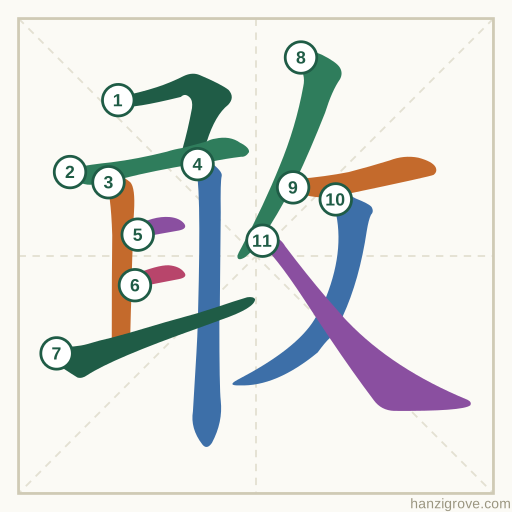
敢 (gǎn) means “to dare”. It is made of 耳 + 攵 and has 11 strokes, and is an HSK 4 word in the current exam syllabus (2025).
Break 敢 into its parts
What 敢 is made of
- 耳 ěr — ear
- 二 — two strokes
- 一 — horizontal stroke
- 一 — horizontal stroke
- 二 — two strokes
- 攵 pū — to rap
- 乂 yì — crossed strokes
- 丿 — falling stroke
- 乂 yì — crossed strokes
Origin hint: A hand with a stick 攵 striking a beast 耳 (from the Make Me a Hanzi dataset; treat as a memory aid where history is uncertain)
敢 stroke order
Example sentences
我不敢一个人去。Wǒ bù gǎn yī gè rén qù.I don't dare to go alone.
你敢吃这个吗?Nǐ gǎn chī zhège ma?Do you dare to eat this?
Words with 敢
Also built with ⿱
- 串chuànstring
- 乐lèhappy
- 亮liàngbright
- 伤shānginjury
- 侃kǎnupright and strong
- 其qíhis
- 具jùtool
- 兼jiānboth
- 兽shòubeast
- 前qiánfront
- 劳láoto labor
- 卸xièto unload
Quick facts
| Pinyin | gǎn |
|---|---|
| Meaning | to dare |
| Strokes | 11 |
| Radical | 攴 (tap, #66) |
| Pattern | Left–right |
| HSK | HSK 4 (exam 2025) · HSK 3 (2021) · Old HSK 4 |
Questions about 敢
What does 敢 mean?
敢 (gǎn) means “to dare”.
How many strokes does 敢 have?
敢 has 11 strokes.
What is the radical of 敢?
The radical of 敢 is 攴 (pū, “tap”), Kangxi radical number 66.
What parts make up 敢?
敢 is made of 耳 (ear) and 攵 (to rap).
Which HSK level is 敢?
敢 is in HSK 4 (exam 2025) and HSK 3 (2021) and Old HSK 4.
Learn 敢 with its group
It is part of HSK 3 (2021) · Group 23: a short group with quick checks and spaced repeats.