
替
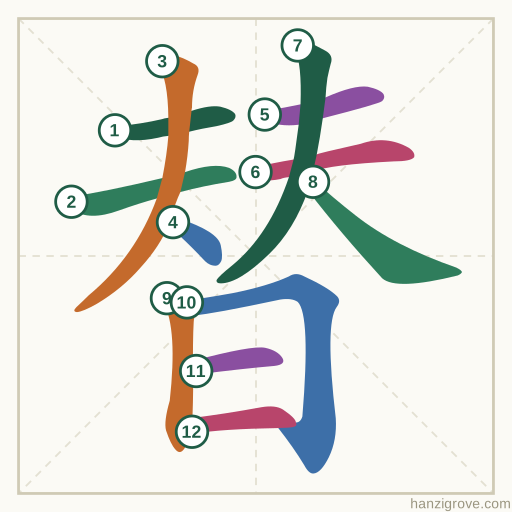
替 (tì) means “for”. It is made of 夫 + 夫 + 日 and has 12 strokes, and is an HSK 4 word in the 2021 standard.
Break 替 into its parts
What 替 is made of
- 夫 fū — man
- 一 — horizontal stroke
- 大 dà — big
- 一 — horizontal stroke
- 人 rén — person
- 夫 fū — man
- 一 — horizontal stroke
- 大 dà — big
- 一 — horizontal stroke
- 人 rén — person
- 日 rì — sun; day
- 口 kǒu — mouth
- 冂 — frame
- 一 — horizontal stroke
- 一 — horizontal stroke
- 口 kǒu — mouth
Origin hint: One man 夫 replacing another; 日 provides the pronunciation (from the Make Me a Hanzi dataset; treat as a memory aid where history is uncertain)
替 stroke order
Example sentences
今天我替他上班。Jīntiān wǒ tì tā shàng bān.Today I'm working in his place.
你能替我去开会吗?Nǐ néng tì wǒ qù kāi huì ma?Can you go to the meeting for me?
Words with 替
Also built with ⿰
- 临línto draw near
- 丽lìbeautiful
- 众zhòngmultitude
- 先xiānfirst
- 册cèvolume
- 勿wùdo not (formal, on signs)
- 压yāto press
- 厨chúkitchen
- 品pǐnarticle
- 哭kūto cry
- 器qìdevice
- 坚jiānhard
Quick facts
| Pinyin | tì |
|---|---|
| Meaning | for; on behalf of; to replace |
| Strokes | 12 |
| Radical | 曰 (say, #73) |
| Pattern | Top–bottom |
| HSK | HSK 4 (2021) |
Questions about 替
What does 替 mean?
替 (tì) means “for; on behalf of; to replace”.
How many strokes does 替 have?
替 has 12 strokes.
What is the radical of 替?
The radical of 替 is 曰 (yuē, “say”), Kangxi radical number 73.
What parts make up 替?
替 is made of 夫 (man) and 夫 (man) and 日 (sun; day).
Which HSK level is 替?
替 is in HSK 4 (2021).
Learn 替 with its group
It is part of HSK 4 (2021) · Group 6: a short group with quick checks and spaced repeats.