
步
步 (bù) means “step”. It is made of 止 and has 7 strokes, and is an HSK 4 word in the current exam syllabus (2025).
Break 步 into its parts
What 步 is made of
- 止 zhǐ — to stop
- 上 shàng — above
- ⺊ — structural part
- 一 — horizontal stroke
- 丨 — vertical stroke
- 上 shàng — above
Origin hint: Modern form of 歨; putting one foot 止 in front of the other (from the Make Me a Hanzi dataset; treat as a memory aid where history is uncertain)
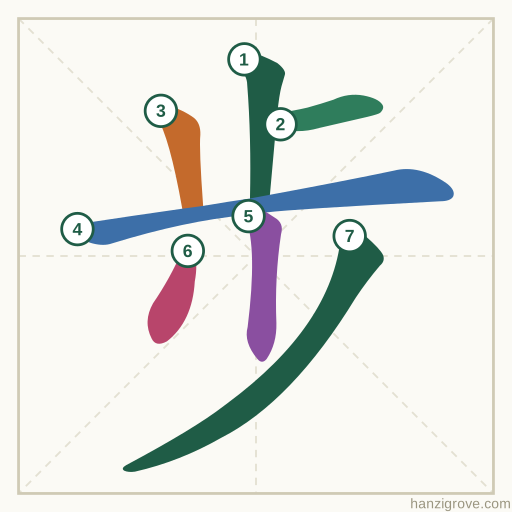
步 stroke order
Example sentences
他往前走了两步。Tā wǎng qián zǒu le liǎng bù.He took two steps forward.
我们去公园散步吧。Wǒmen qù gōngyuán sànbù ba.Let's go for a walk in the park.
Words with 步
- 初步chūbùinitial
- 进步jìnbùto make progress
- 进一步jìnyībùfurther
- 跑步pǎobùto run
- 散步sànbùto take a walk
- 步行bùxíngto walk
- 逐步zhúbùstep by step
- 步骤bùzhòustep
- 退步tuìbùto fall behind
- 步伐bùfápace
- 地步dìbùextent
- 让步ràngbùto make a concession
Also built with 止
- 企qǐto plan a project
- 址zhǐlocation
- 扯chěto rip
- 正zhèngstraight
- 此cǐthis
- 歧qíto diverge
- 耻chǐshame
- 肯kěnto agree to
- 走zǒuto walk
- 齿chǐteeth
Quick facts
| Pinyin | bù |
|---|---|
| Meaning | step; pace |
| Strokes | 7 |
| Radical | 止 (stop, #77) |
| Pattern | Top–bottom |
| HSK | HSK 4 (exam 2025) · HSK 3 (2021) |
Questions about 步
What does 步 mean?
步 (bù) means “step; pace”.
How many strokes does 步 have?
步 has 7 strokes.
What is the radical of 步?
The radical of 步 is 止 (zhǐ, “stop”), Kangxi radical number 77.
What parts make up 步?
步 is made of 止 (to stop).
Which HSK level is 步?
步 is in HSK 4 (exam 2025) and HSK 3 (2021).
Learn 步 with its group
It is part of HSK 3 (2021) · Group 66: a short group with quick checks and spaced repeats.