
比
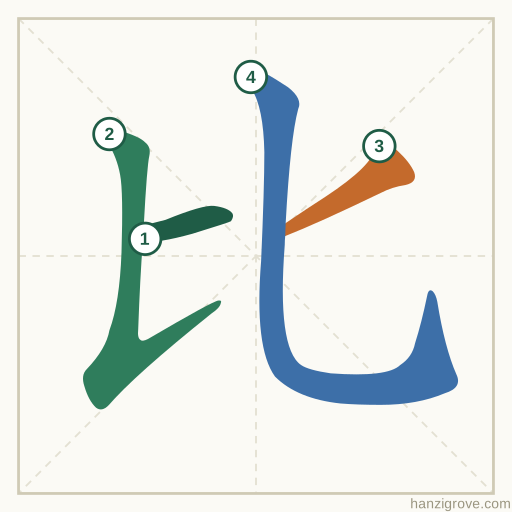
比 (bǐ) means “to compare”. It is made of 匕 + 匕 and has 4 strokes, and is an HSK 2 word in the current exam syllabus (2025).
Break 比 into its parts
What 比 is made of
- 匕 bǐ — spoon
- 乚 — hook stroke
- 丿 — falling stroke
- 匕 bǐ — spoon
- 乚 — hook stroke
- 丿 — falling stroke
Origin hint: Two spoons 匕 side-by-side; 匕 also provides the pronunciation (from the Make Me a Hanzi dataset; treat as a memory aid where history is uncertain)
比 stroke order
Example sentences
我比他高。Wǒ bǐ tā gāo.I'm taller than him.
今天比昨天冷吗?Jīntiān bǐ zuótiān lěng ma?Is today colder than yesterday?
Words with 比
- 比如bǐrúfor example
- 比如说bǐrúshuōfor example
- 比较bǐjiàofairly
- 比例bǐlìproportion
- 比赛bǐsàimatch
- 相比xiāngbǐto compare
- 比分bǐfēnscore
- 对比duìbǐto compare
- 比方bǐfangfor example
- 比喻bǐyùmetaphor
- 比重bǐzhòngproportion
- 无比wúbǐincomparable
Also built with 匕
Quick facts
| Pinyin | bǐ |
|---|---|
| Meaning | to compare; than |
| Strokes | 4 |
| Radical | 比 (compare, #81) |
| Pattern | Left–right |
| HSK | HSK 2 (exam 2025) · HSK 1 (2021) · Old HSK 2 |
Questions about 比
What does 比 mean?
比 (bǐ) means “to compare; than”.
How many strokes does 比 have?
比 has 4 strokes.
What is the radical of 比?
The radical of 比 is 比 (bǐ, “compare”), Kangxi radical number 81.
What parts make up 比?
比 is made of 匕 (spoon) and 匕 (spoon).
Which HSK level is 比?
比 is in HSK 2 (exam 2025) and HSK 1 (2021) and Old HSK 2.
Learn 比 with its group
It is part of HSK 1 (2021) · Group 32: a short group with quick checks and spaced repeats.