
着
HSK 2 (exam 2025)HSK 1 (2021)Old HSK 2
着 (zhe) · ongoing-state particle
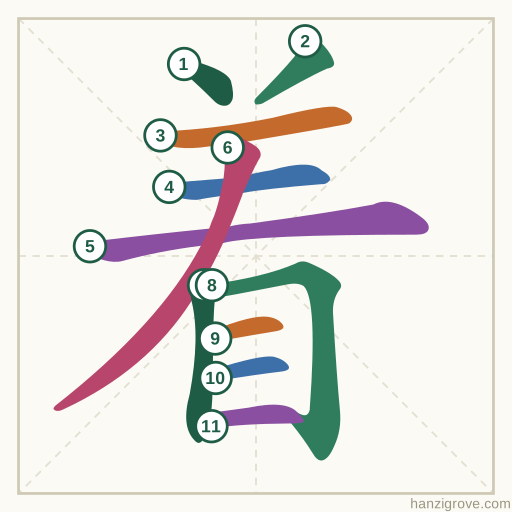
着 (zhe) means “ongoing-state particle”. It is made of 羊 + 目 and has 11 strokes, and is an HSK 2 word in the current exam syllabus (2025).
Break 着 into its parts
What 着 is made of
- 羊 yáng — sheep
- 丷 ha — kwukyel
- 丶 — dot
- 丷 ha — kwukyel
- 目 mù — eye
- 口 kǒu — mouth
- 冂 — frame
- 一 — horizontal stroke
- 二 — two strokes
- 一 — horizontal stroke
- 一 — horizontal stroke
- 口 kǒu — mouth
着 stroke order
Example sentences
她穿着新衣服。Tā chuān zhe xīn yīfu.She is wearing new clothes.
门还开着吗?Mén hái kāi zhe ma?Is the door still open?
Words with 着
- 接着jiēzheto continue
- 睡着shuìzháoto fall asleep
- 着火zháohuǒto catch fire
- 着急zháojíworried
- 随着suízhealong with
- 着凉zháoliángto catch a cold
- 沉着chénzhuócalm
- 意味着yìwèizheto mean
- 着迷zháomíto be fascinated
- 执着zhízhuópersistent
- 着手zhuóshǒuto set about
- 着想zhuóxiǎngto consider (others' interests)
- 着重zhuózhòngto emphasise
- 有着yǒuzheto have
Also built with 羊
- 养yǎngto raise (animals)
- 善shàngood
- 差chàpoor
- 样yàngform
- 氧yǎngoxygen
- 洋yángsea
- 痒yǎngitchy
- 盖gàilid
- 祥xiánghappiness
- 美měibeautiful
- 羞xiūshame
- 羡xiànto envy
Quick facts
| Pinyin | zhe |
|---|---|
| Meaning | ongoing-state particle |
| Strokes | 11 |
| Radical | 目 (eye, #109) |
| Pattern | Top-left wrap |
| HSK | HSK 2 (exam 2025) · HSK 1 (2021) · Old HSK 2 |
Questions about 着
What does 着 mean?
着 (zhe) means “ongoing-state particle”.
How many strokes does 着 have?
着 has 11 strokes.
What is the radical of 着?
The radical of 着 is 目 (mù, “eye”), Kangxi radical number 109.
What parts make up 着?
着 is made of 羊 (sheep) and 目 (eye).
Which HSK level is 着?
着 is in HSK 2 (exam 2025) and HSK 1 (2021) and Old HSK 2.
Learn 着 with its group
It is part of HSK 1 (2021) · Group 24: a short group with quick checks and spaced repeats.