
被
HSK 3 (exam 2025)HSK 3 (2021)Old HSK 3
被 (bèi) · by (marks the passive)
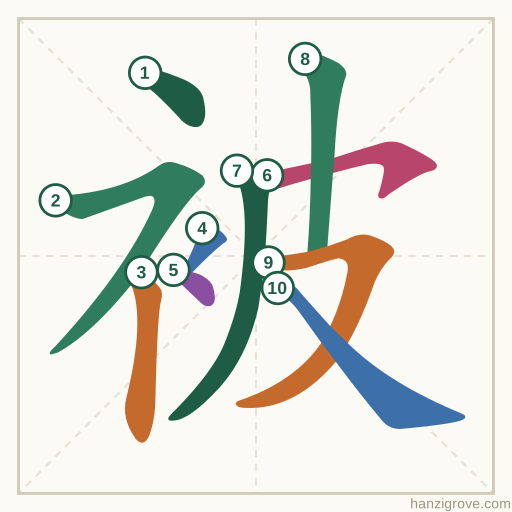
被 (bèi) means “by (marks the passive)”. It is made of 衤 + 皮 and has 10 strokes, and is an HSK 3 word in the current exam syllabus (2025).
Break 被 into its parts
What 被 is made of
- 衤 yī — clothing
- 皮 pí — skin
- 攴 pū — to rap
Origin hint: 衤 gives the meaning, 皮 gives the sound. (from the Make Me a Hanzi dataset; treat as a memory aid where history is uncertain)
被 stroke order
Example sentences
我的自行车被人骑走了。Wǒ de zìxíngchē bèi rén qízǒu le.Someone rode off on my bike.
杯子被弟弟打破了。Bēizi bèi dìdi dǎpò le.The cup was broken by my little brother.
Words with 被
Also built with 衤
- 初chūfirst (as in 初一)
- 补bǔto mend
- 衫shānshirt
- 衬chènunderwear
- 袍páorobe
- 袖xiùsleeve
- 袜wàsocks
- 袱fúapants
- 裕yùrich
- 裙qúnskirt
- 裤kùpants
Quick facts
| Pinyin | bèi |
|---|---|
| Meaning | by (marks the passive); quilt |
| Strokes | 10 |
| Radical | 衣 (clothes, #145) |
| Pattern | Left–right |
| HSK | HSK 3 (exam 2025) · HSK 3 (2021) · Old HSK 3 |
Questions about 被
What does 被 mean?
被 (bèi) means “by (marks the passive); quilt”.
How many strokes does 被 have?
被 has 10 strokes.
What is the radical of 被?
The radical of 被 is 衣 (yī, “clothes”), Kangxi radical number 145.
What parts make up 被?
被 is made of 衤 (clothing) and 皮 (skin).
Which HSK level is 被?
被 is in HSK 3 (exam 2025) and HSK 3 (2021) and Old HSK 3.
Learn 被 with its group
It is part of HSK 3 (2021) · Group 32: a short group with quick checks and spaced repeats.