
Chinese character for dream: 梦 (mèng)
The Chinese character for dream is 梦 (mèng). It means a dream while sleeping and also a dream or goal in life, as in 梦想 (mèngxiǎng, dream, aspiration). 做梦 (zuò mèng) means to have a dream.
How 梦 is built
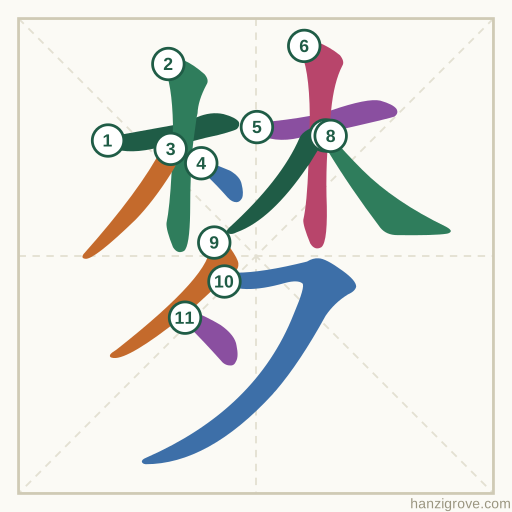
The simplified 梦 has 林 (lín, woods) above 夕 (xī, evening). As a memory aid, picture dreaming under the trees at night. The traditional form 夢 is quite different: it has grass and an eye at the top, a cover, and 夕 (evening) at the bottom, often explained as eyes closed in the night. Both forms keep 夕, the evening, which connects dreams to night-time.
梦 mèng · dream
- 林lín — forest
- 木mù — tree
- 十 — ten
- 八bā — eight
- 木mù — tree
- 十 — ten
- 八bā — eight
- 木mù — tree
- 夕xī — evening
- 勹bāo — wrap shape
- 丿 — falling stroke
- 丶 — dot
- 勹bāo — wrap shape
Origin hint: Two eyes shut 林 at night 夕 (from the Make Me a Hanzi dataset; treat as a memory aid where history is uncertain)
How 梦 is used
Other ways to say dream
- 梦想 mèngxiǎng — a life goal or aspiration, not a sleeping dream
Before you use it as a tattoo or design: For a life ambition use 梦想; 梦 alone means a dream in general, and its traditional form 夢 looks very different.
Questions
What is the Chinese character for dream?
梦 (mèng) means “dream”. In traditional characters it is written 夢.
How do you pronounce 梦?
梦 is pronounced mèng.
Is 梦 simplified or traditional?
梦 is the simplified form used in mainland China and Singapore; 夢 is the traditional form used in Taiwan and Hong Kong.