
Chinese character for joy: 乐 (lè)
The Chinese character for joy is 乐 (lè). It means happy, joyful or cheerful, as in 快乐 (kuàilè, happy). The same character is read yuè when it means music, as in 音乐 (yīnyuè).
How 乐 is built
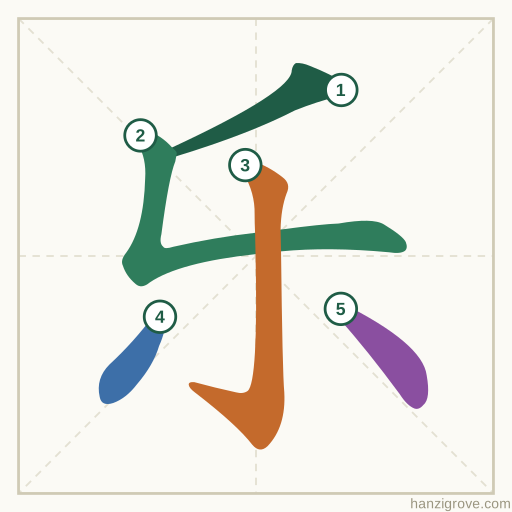
The traditional form 樂 shows a musical instrument: silk strings 幺 on either side of 白 set on a wooden frame 木. Music brought joy, so the character came to mean both music (yuè) and joy (lè). The simplified form 乐 is a much shorter cursive version of the same character. As a memory aid, link joy with the sound of music played on a wooden instrument.
乐 lè · happy
- 丿 — falling stroke
- 小xiǎo — small
- 亅 — hook
- 八bā — eight
Origin hint: Simplified form of 樂, a musical instrument with wood 木, strings 幺, and a pick 白 (from the Make Me a Hanzi dataset; treat as a memory aid where history is uncertain)
How 乐 is used
Other ways to say joy
- 喜 xǐ — joy, used for celebrations and weddings
- 快乐 kuàilè — everyday word for happy
Before you use it as a tattoo or design: Decide between simplified 乐 and the more detailed traditional 樂, and note that a single 乐 can also read as 'music' without context.
Questions
What is the Chinese character for joy?
乐 (lè) means “joy”. In traditional characters it is written 樂.
How do you pronounce 乐?
乐 is pronounced lè.
Is 乐 simplified or traditional?
乐 is the simplified form used in mainland China and Singapore; 樂 is the traditional form used in Taiwan and Hong Kong.