
Chinese character for learn: 学 (xué)
The Chinese character for learn is 学 (xué). It means to learn or study and appears in 学习 (xuéxí, to study), 学生 (xuésheng, student) and 学校 (xuéxiào, school). It is one of the first characters Chinese learners meet.
How 学 is built
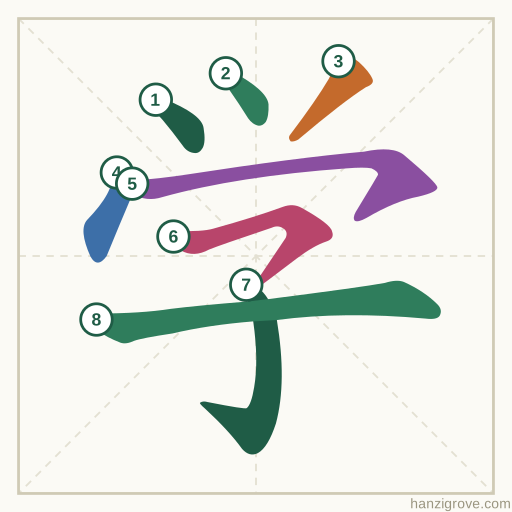
The bottom of 学 is 子 (zǐ), a child. Above it is 冖, a roof or cover, and the three short strokes ⺍ at the top. The traditional form 學 shows two hands holding 爻, crossed counting sticks or lessons, above a roof and a child. As a memory aid, 学 is a child under a roof being handed knowledge. The simplified form keeps the child and roof but shortens the top.
学 xué · to study
- ⺍ — three-stroke
- 冖mì — cover
- 子zǐ — child
- 了liǎo / le — finish
- 乛 — bent stroke
- 亅 — hook
- 一 — horizontal stroke
- 了liǎo / le — finish
Origin hint: A building 冖 where children 子 study; ⺍ provides the pronunciation (from the Make Me a Hanzi dataset; treat as a memory aid where history is uncertain)
How 学 is used
Other ways to say learn
- 学习 xuéxí — to study, the everyday verb
- 习 xí — to practise, review
Before you use it as a tattoo or design: Pick simplified 学 or traditional 學 deliberately; 学 is what learners in mainland China and most textbooks use.
Questions
What is the Chinese character for learn?
学 (xué) means “to learn”. In traditional characters it is written 學.
How do you pronounce 学?
学 is pronounced xué.
Is 学 simplified or traditional?
学 is the simplified form used in mainland China and Singapore; 學 is the traditional form used in Taiwan and Hong Kong.