
Chinese character for person: 人 (rén)
The Chinese character for person is 人 (rén). It means person, people or human, and appears in 人们 (rénmen, people) and 中国人 (Zhōngguó rén, Chinese person). It is one of the first characters learners meet.
How 人 is built
人 is a pictograph of a person seen from the side, walking, with two legs. In ancient forms you can also see an arm reaching forward. As a part of other characters it often appears on the left as 亻, as in 你 (you), 他 (he) and 信 (trust). Inside 大 (big) and 天 (sky) you can see a person with arms spread. It is identical in simplified and traditional Chinese.
人 rén · person
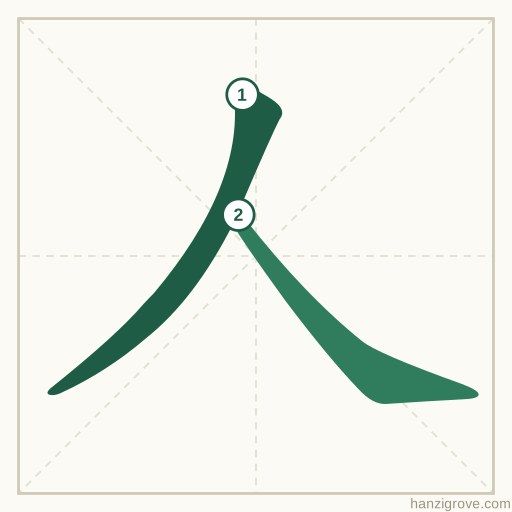
人 is not built from smaller parts; it is written with 2 strokes.
Origin hint: The legs of a human being (from the Make Me a Hanzi dataset; treat as a memory aid where history is uncertain)
How 人 is used
Before you use it as a tattoo or design: 人 is identical in both scripts; it is often confused with 入 (rù, to enter), which leans the other way.
Questions
What is the Chinese character for person?
人 (rén) means “person”.
How do you pronounce 人?
人 is pronounced rén.