
搂
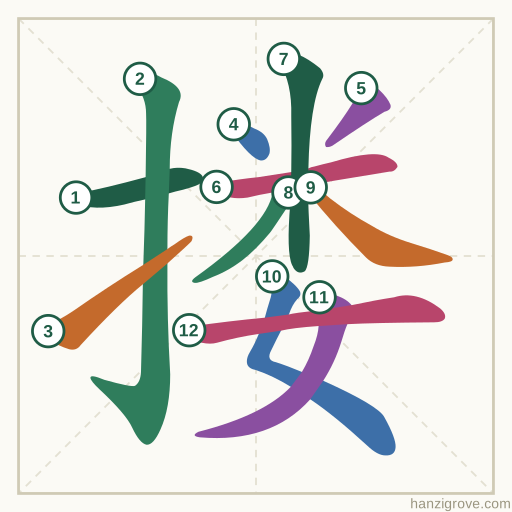
搂 (lǒu) means “to hug”. It is made of 扌 + 娄 and has 12 strokes, and is an old HSK 6 word (HSK 2.0).
Break 搂 into its parts
What 搂 is made of
- 扌 shǒu — hand
- 二 — two strokes
- 一 — horizontal stroke
- 一 — horizontal stroke
- 亅 — hook
- 二 — two strokes
- 娄 lóu — a constellation
- 米 mǐ — rice
- 丷 ha — kwukyel
- 木 mù — tree
- 女 nǚ — woman
- 米 mǐ — rice
搂 stroke order
Example sentences
妈妈把孩子搂在怀里。Māma bǎ háizi lǒu zài huáilǐ.The mother held her child in her arms.
他搂着朋友的肩膀拍照。Tā lǒuzhe péngyou de jiānbǎng pāizhào.He put his arm around his friend's shoulder for a photo.
Also built with 扌
- 举jǔto raise
- 我wǒI
- 才cáitalent
- 扎zhāto prick
- 扑pūto pounce on
- 扒bāto hold on to
- 打dǎto play (ball)
- 扔rēngto throw
- 托tuōto raise
- 扛kángto carry on the shoulder
- 扣kòuto fasten
- 执zhíto execute
Quick facts
| Pinyin | lǒu |
|---|---|
| Meaning | to hug; to hold in one's arms |
| Strokes | 12 |
| Pattern | Left–right |
| HSK | Old HSK 6 |
Questions about 搂
What does 搂 mean?
搂 (lǒu) means “to hug; to hold in one's arms”.
How many strokes does 搂 have?
搂 has 12 strokes.
What parts make up 搂?
搂 is made of 扌 (hand) and 娄 (a constellation).
Which HSK level is 搂?
搂 is in Old HSK 6.
Learn 搂 with its group
It is part of Old HSK 6 · Group 120: a short group with quick checks and spaced repeats.