
穷
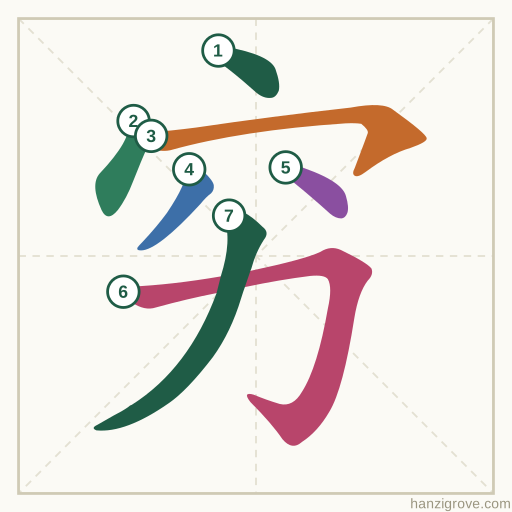
穷 (qióng) means “poor”. It is made of 穴 + 力 and has 7 strokes, and is an HSK 4 word in the 2021 standard.
Break 穷 into its parts
What 穷 is made of
- 穴 xué — cave
- 宀 — roof
- 丶 — dot
- 冖 mì — cover
- 八 bā — eight
- 宀 — roof
- 力 lì — strength
- 丿 — falling stroke
穷 stroke order
Example sentences
他小时候家里很穷。Tā xiǎoshíhou jiā lǐ hěn qióng.His family was very poor when he was young.
这个村子以前很穷。Zhè ge cūnzi yǐqián hěn qióng.This village used to be very poor.
Words with 穷
Also built with 穴
- 帘liánthe flag-sign of a tavern
- 究jiūto dig into
- 空kōngempty
- 穿chuānto wear
- 突tūsudden
- 窃qièto steal
- 窄zhǎinarrow
- 窍qiàohole
- 窗chuāngwindow
- 窜cuànto flee
- 窝wōnest
Quick facts
| Pinyin | qióng |
|---|---|
| Meaning | poor |
| Strokes | 7 |
| Radical | 穴 (cave, #116) |
| Pattern | Top–bottom |
| HSK | HSK 4 (2021) · Old HSK 4 |
Questions about 穷
What does 穷 mean?
穷 (qióng) means “poor”.
How many strokes does 穷 have?
穷 has 7 strokes.
What is the radical of 穷?
The radical of 穷 is 穴 (xué, “cave”), Kangxi radical number 116.
What parts make up 穷?
穷 is made of 穴 (cave) and 力 (strength).
Which HSK level is 穷?
穷 is in HSK 4 (2021) and Old HSK 4.
Learn 穷 with its group
It is part of HSK 4 (2021) · Group 89: a short group with quick checks and spaced repeats.