
Chinese character for martial arts: 武 (wǔ)
The Chinese character for martial arts is 武 (wǔ). It means martial or military and appears in 武术 (wǔshù, martial arts, wushu) and 武功 (wǔgōng, martial skill). It is the character at the heart of Chinese fighting arts.
How 武 is built
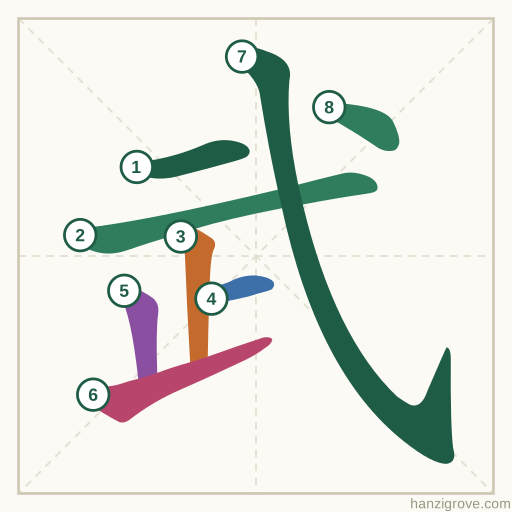
武 joins 止 (zhǐ), a foot, with 弋, a form of 戈 (gē), a halberd. Scholars read it as a foot marching with a weapon, soldiers on the move. A famous traditional reading, found in ancient texts, takes 止 as 'to stop' and explains 武 as 'stopping the weapons', the idea that true martial strength prevents fighting. 武 is identical in simplified and traditional Chinese.
武 wǔ · military
- 一 — horizontal stroke
- 弋yì — to catch
- 止zhǐ — to stop
- 上shàng — above
- ⺊ — structural part
- 一 — horizontal stroke
- 丨 — vertical stroke
- 上shàng — above
Origin hint: To stop someone 止 with an arrow 弋 (from the Make Me a Hanzi dataset; treat as a memory aid where history is uncertain)
How 武 is used
Other ways to say martial arts
- 武术 wǔshù — martial arts as a sport or practice
- 功夫 gōngfu — kung fu; skill from hard work
Before you use it as a tattoo or design: 武 is identical in both scripts and widely recognized; the dot at upper right belongs to the weapon part and must not be left out.
Questions
What is the Chinese character for martial arts?
武 (wǔ) means “martial”.
How do you pronounce 武?
武 is pronounced wǔ.