
Chinese character for yin and yang: 阴阳 (yīnyáng)
The Chinese word for yin and yang is 阴阳 (yīnyáng). It names the two opposite but connected forces in Chinese philosophy: yin is dark, cool and soft, yang is bright, warm and active. The idea is shown by the familiar black-and-white circle symbol.
How 阴阳 is built
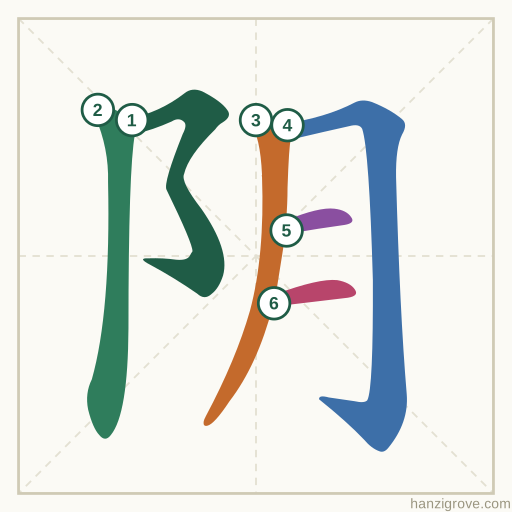
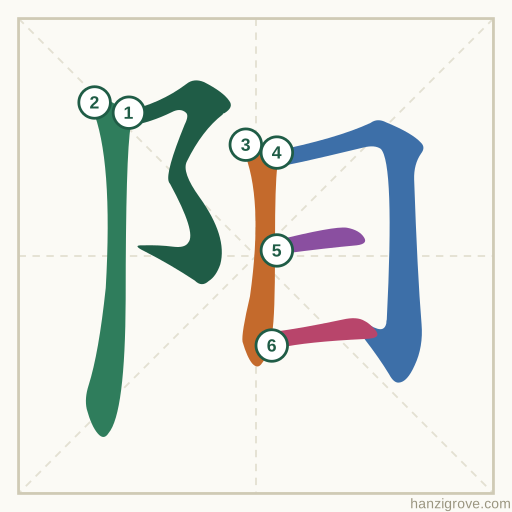
Both characters have 阝 on the left, which here means a hill. 阴 (yīn) adds 月 (moon), and 阳 (yáng) adds 日 (sun). Their first meanings were the shady side and the sunny side of a hill, a clear picture of opposites that belong together. The traditional forms 陰 and 陽 use different right-hand parts with the same meanings. Together they express balance in all things.
阴 yīn · cloudy
- 阝fù / yì (names) — mound/city side-form
- 丨 — vertical stroke
- 月yuè — moon; month
- 冂 — frame
- 丨 — vertical stroke
- 二 — two strokes
- 一 — horizontal stroke
- 一 — horizontal stroke
- 冂 — frame
Origin hint: The place 阝 of the moon 月; compare 阳 (from the Make Me a Hanzi dataset; treat as a memory aid where history is uncertain)
阳 yáng · the male principle
- 阝fù / yì (names) — mound/city side-form
- 丨 — vertical stroke
- 日rì — sun; day
- 口kǒu — mouth
- 冂 — frame
- 一 — horizontal stroke
- 一 — horizontal stroke
- 口kǒu — mouth
Origin hint: The place 阝 of the sun 日; compare 阴 (from the Make Me a Hanzi dataset; treat as a memory aid where history is uncertain)
How 阴阳 is used
Before you use it as a tattoo or design: Many people use the traditional 陰陽; the simplified 阴阳 is clearer to show the moon 月 and sun 日 inside.
Questions
What is the Chinese character for yin and yang?
阴阳 (yīnyáng) means “yin and yang”. In traditional characters it is written 陰陽.
How do you pronounce 阴阳?
阴阳 is pronounced yīnyáng.
Is 阴阳 simplified or traditional?
阴阳 is the simplified form used in mainland China and Singapore; 陰陽 is the traditional form used in Taiwan and Hong Kong.