
待
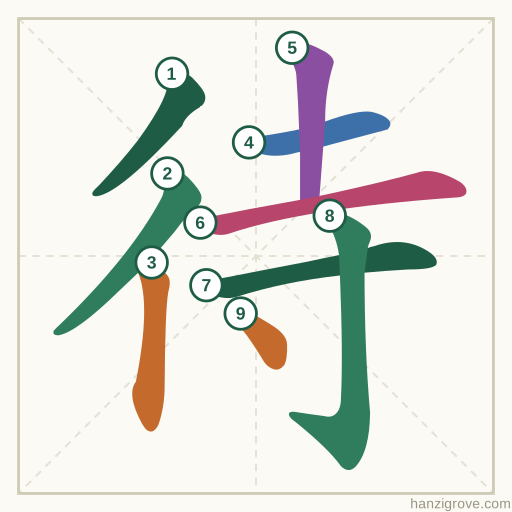
待 (dāi) means “to stay”. It is made of 彳 + 寺 and has 9 strokes, and is an HSK 4 word in the current exam syllabus (2025).
Break 待 into its parts
What 待 is made of
- 彳 chì — to step with the left foot
- 丨 — vertical stroke
- 寺 sì — court
- 土 tǔ — earth
- 十 — ten
- 一 — horizontal stroke
- 寸 cùn — inch
- 土 tǔ — earth
Origin hint: To welcome someone arriving 彳 at the royal court 寺 (from the Make Me a Hanzi dataset; treat as a memory aid where history is uncertain)
待 stroke order
Example sentences
我在家待了一天。Wǒ zài jiā dāi le yì tiān.I stayed at home all day.
你在这儿多待一会儿吧。Nǐ zài zhèr duō dāi yíhuìr ba.Stay here a little longer.
Words with 待
- 等待děngdàito wait
- 对待duìdàito treat
- 接待jiēdàito receive (guests)
- 待遇dàiyùpay
- 期待qīdàito look forward to
- 招待zhāodàito entertain (guests)
- 看待kàndàito regard
- 款待kuǎndàito treat cordially
- 亏待kuīdàito treat unfairly
- 虐待nüèdàito mistreat
- 迫不及待pòbùjídàitoo impatient to wait
Also built with 彳
- 役yìservant
- 彻chèpenetrating
- 彼bǐthat
- 往wǎngtowards
- 征zhēngto summon
- 径jìngpath
- 很hěnvery
- 徊huáito linger
- 律lǜstatute
- 徒túdisciple
- 得déto get
- 徘páito dither
Quick facts
| Pinyin | dāi |
|---|---|
| Meaning | to stay |
| Strokes | 9 |
| Radical | 彳 (step, #60) |
| Pattern | Left–right |
| HSK | HSK 4 (exam 2025) |
Questions about 待
What does 待 mean?
待 (dāi) means “to stay”.
How many strokes does 待 have?
待 has 9 strokes.
What is the radical of 待?
The radical of 待 is 彳 (chì, “step”), Kangxi radical number 60.
What parts make up 待?
待 is made of 彳 (to step with the left foot) and 寺 (court).
Which HSK level is 待?
待 is in HSK 4 (exam 2025).
Learn 待 with its group
It is part of HSK 4 · Group 13: a short group with quick checks and spaced repeats.