
Chinese character for lion: 狮 (shī)
The Chinese character for lion is 狮 (shī). It means lion and appears in 狮子 (shīzi, lion), the everyday word, and 舞狮 (wǔshī, lion dance). Stone lions guard the gates of many Chinese buildings.
How 狮 is built
狮 joins 犭, the animal radical, with 师 (shī, teacher, master), which gives the sound. The traditional form 獅 uses 師, the traditional form of 师. As a memory aid, the lion is the master 师 of the animals 犭. Lions are not native to China, so the name was formed from sound, and the animal became a protective symbol through art and the lion dance.
狮 shī · lion
- 犭quǎn — dog
- 师shī — teacher
- 刂dāo — knife
- 丨 — vertical stroke
- 亅 — hook
- 帀zā — to rotate
- 一 — horizontal stroke
- 巾jīn — cloth
- 刂dāo — knife
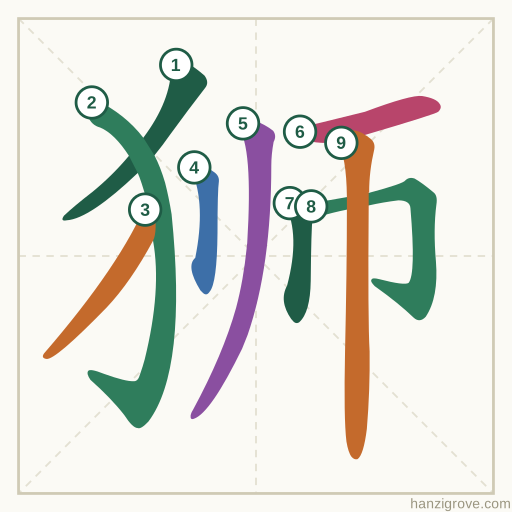
How 狮 is used
Other ways to say lion
- 狮子 shīzi — lion, the everyday spoken word
Before you use it as a tattoo or design: 狮子 is what people say; 狮 alone is understood but reads more like part of a word.
Questions
What is the Chinese character for lion?
狮 (shī) means “lion”. In traditional characters it is written 獅.
How do you pronounce 狮?
狮 is pronounced shī.
Is 狮 simplified or traditional?
狮 is the simplified form used in mainland China and Singapore; 獅 is the traditional form used in Taiwan and Hong Kong.