
Chinese character for victory: 胜 (shèng)
The Chinese character for victory is 胜 (shèng). It means to win or victory, and appears in 胜利 (shènglì, victory) and 必胜 (bìshèng, sure to win). It is often written on banners at sports events.
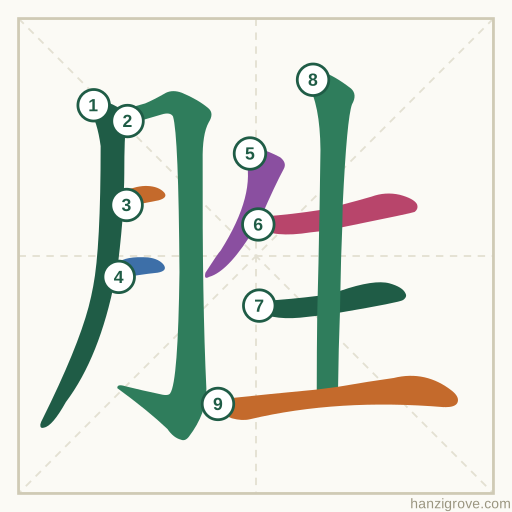
How 胜 is built
The traditional form 勝 joins 朕 with 力 (lì, strength), so the meaning of winning comes through strength. The simplified form 胜 was originally a different character, made of 月 (flesh) and 生 (shēng), which gives the sound, and was chosen to replace 勝 because it is simpler. As a memory aid, 胜 is a living body 生 at full strength that wins.
胜 shèng · to win
- ⺼ — meat
- 生shēng — life
- 一 — horizontal stroke
- 土tǔ — earth
- 十 — ten
- 一 — horizontal stroke
Origin hint: ⺼ gives the meaning, 生 gives the sound. (from the Make Me a Hanzi dataset; treat as a memory aid where history is uncertain)
How 胜 is used
Other ways to say victory
- 胜利 shènglì — victory, the usual noun
- 赢 yíng — to win (a game), everyday speech
Before you use it as a tattoo or design: The traditional 勝 contains 力 (strength) and looks quite different from 胜, so be sure which one you want.
Questions
What is the Chinese character for victory?
胜 (shèng) means “victory”. In traditional characters it is written 勝.
How do you pronounce 胜?
胜 is pronounced shèng.
Is 胜 simplified or traditional?
胜 is the simplified form used in mainland China and Singapore; 勝 is the traditional form used in Taiwan and Hong Kong.